Tiếng Việt
 English
 中文
 Español
 हिन्दी
 Français
 Português
 Русский
 Deutsch
 日本語
 한국어
 Italiano
 Bahasa Indonesia
 ไทย
 বাংলা
 ລາວ
 မြန်မာ
 العربية
 فارسی
 اردو
 Українська
 Română
 Azərbaycan
For decades, contemporary internet security architecture has rested firmly on classical computational complexity: the integer factorization problem underlying RSA and the discrete logarithm problem over elliptic curves (ECDH using Curve25519 or Secp256r1). On conventional binary computing hardware, resolving these cryptographic equations via brute-force enumeration requires millions of CPU-years.
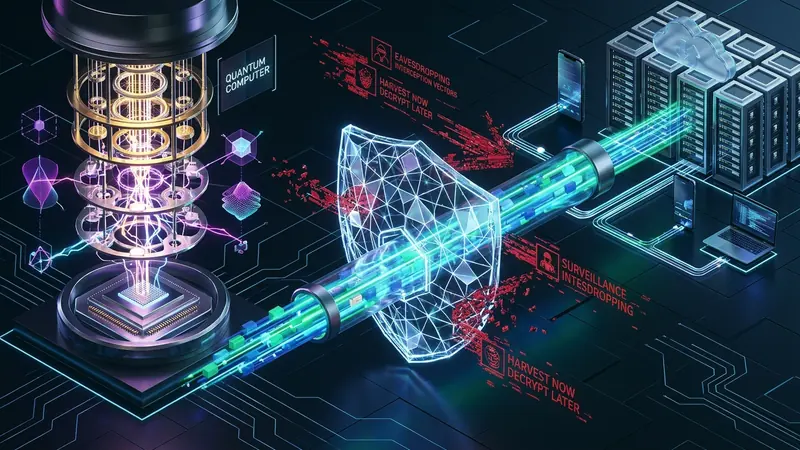
The advent of quantum computing fundamentally reshapes this operational baseline. When a cryptographically relevant quantum computer (CRQC) executing Shor's Algorithm reaches operational maturity, every classical asymmetric cryptographic exchange deployed across global networks will be vulnerable to polynomial-time key recovery.
The Operational Reality of "Harvest Now, Decrypt Later" (HNDL)
A pervasive misconception in network administration is that quantum threats remain a distant concern that warrants attention only when hardware arrives. In offensive cyber operations, state-sponsored actors and signals intelligence organizations are actively executing large-scale Harvest Now, Decrypt Later (HNDL) surveillance campaigns today.
The mechanics of an HNDL attack follow two distinct phases:
- Passive Ingestion and Storage: Interception equipment deployed across international internet exchange points (IXPs) and transoceanic fiber backbones continuously captures encrypted VPN sessions, corporate intellectual property transfers, and private communications. These vast petabyte-scale datasets are preserved in deep cold-storage repositories.
- Retrospective Cryptanalysis: Once a quantum computer achieves sufficient fault-tolerant physical qubits, adversaries will systematically process historical captures. By breaking the ephemeral Diffie-Hellman key exchanges recorded years prior, they reconstruct the symmetric session keys and expose historical traffic in plain text.
For sensitive corporate assets, proprietary software architectures, healthcare records, and digital identity credentials that demand confidentiality for ten to thirty years, the threat of retrospective decryption is an immediate problem.
NIST FIPS 203 ML-KEM and the Hybrid Key Exchange Architecture
To neutralize quantum cryptanalysis, the United States National Institute of Standards and Technology (NIST) finalized FIPS 203, establishing the standard for Module-Lattice-Based Key-Encapsulation Mechanisms (ML-KEM), formerly known as CRYSTALS-Kyber.
Lattice-based cryptography relies on the hardness of the Learning With Errors (LWE) problem across multi-dimensional geometric lattices. These mathematical structures exhibit no known periodic properties that Shor's Algorithm or Grover's Algorithm can exploit, providing robust resistance against both classical and quantum computing paradigms.
However, completely replacing proven classical algorithms with novel post-quantum mathematics introduces unknown implementation risks. The cryptographic consensus across standards bodies (including the IETF in RFC 9370) mandates a Hybrid Key Exchange approach:
- Dual Mathematical Primitives: The protocol couples an extensively audited classical elliptic curve algorithm (X25519) with a post-quantum lattice mechanism (ML-KEM-768).
- HKDF Key Fusion: The final symmetric session encryption key is derived by feeding both shared secrets into a secure HMAC-based Extract-and-Expand Key Derivation Function (HKDF).
- Defense in Depth: An attacker must simultaneously break both classical discrete logarithms and high-dimensional lattice problems to recover the session keys. If unexpected vulnerabilities are discovered in either primitive, the complementary cipher guarantees continuous data confidentiality.
Network Challenges: UDP Fragmentation and Layer 3 Clamping
Integrating post-quantum algorithms into high-throughput Layer 3 VPN protocols introduces substantial physical packet constraints:
- Classical WireGuard handshakes utilize 32-byte X25519 public keys, resulting in compact 148-byte initial handshake messages that easily traverse standard 1500-byte Maximum Transmission Unit (MTU) boundaries.
- Conversely, ML-KEM-768 requires public keys of 1,184 bytes and produces ciphertexts of 1,088 bytes.
- Encapsulating these larger payloads into initial UDP datagrams pushes overall packet sizes beyond standard network MTU ceilings. This triggers IP fragmentation at intermediate middleboxes. Because many enterprise firewalls, residential broadband gateways, and cellular networks aggressively drop fragmented UDP datagrams, unoptimized post-quantum handshakes experience severe connection timeouts.
VPNRice solves this transmission bottleneck through its optimized RiceGuard Layer 3 architecture. By implementing Post-Quantum Pre-Shared Key mechanisms (PQ-PSK, standardized in RFC 8784) and dynamic Path MTU Clamping, VPNRice eliminates UDP fragmentation. Connection initiation packets are held strictly within safe MTU thresholds (1280 bytes on IPv6 links), ensuring instantaneous tunnel negotiation and complete resistance against quantum interception.
Recommended Hardening Steps for Long-Term Data Privacy
To insulate your digital traffic against automated HNDL capture programs:
- Enforce Quantum-Resistant Hybrid Keying: Where client options exist, ensure your VPN connection utilizes hybrid key exchange algorithms (such as X25519 combined with Kyber768 or ML-KEM) for all long-distance internet traffic.
- Maintain Frequent Ephemeral Rekeying: Verify that your connection stack enforces strict forward secrecy by renegotiating ephemeral session keys every few minutes, preventing any single compromise from exposing historical data streams.
- Encapsulate DNS Traffic Fully: Ensure all domain name lookups are resolved inside the encrypted VPN tunnel, preventing third-party transit networks from cataloging your destination endpoints.
- Tune Connection MTU Safely: Configure your network interfaces with an adaptive MTU between 1280 and 1380 bytes to eliminate packet fragmentation and drop rates across complex transport routes.
Migrating to post-quantum cryptographic defenses today is the definitive technical countermeasure to preserve data sovereignty and privacy well into the quantum computing era.