 Tiếng Việt
 English
 中文
 Español
 हिन्दी
 Français
 Português
 Русский
 Deutsch
 日本語
 한국어
 Italiano
 Bahasa Indonesia
 ไทย
 বাংলা
 ລາວ
 မြန်မာ
 العربية
 فارسی
 اردو
 Українська
 Română
 Azərbaycan
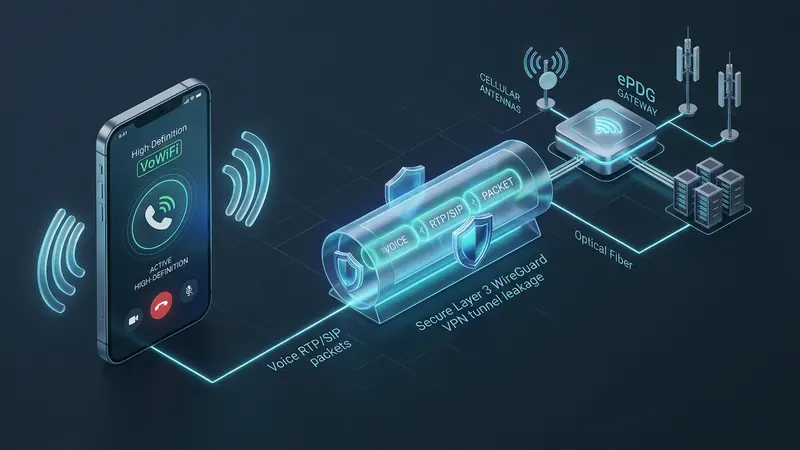
Wi-Fi Calling (Voice over Wi-Fi or VoWiFi) has become an indispensable feature on modern iOS and Android smartphones. By routing cellular voice traffic and SMS text messages over local wireless connections, it eliminates dead zones inside concrete basements, high-rise buildings, and rural areas where cellular radio frequency signals fail to penetrate.
Behind this seamless handoff lies a sophisticated cellular networking stack. Whenever a handset switches from an LTE or 5G cell tower to a local Wi-Fi router, it interacts with telecom core network components. While the primary voice payload is protected by encryption, the underlying operational protocols introduce critical vulnerabilities: unencrypted subscriber identity queries, geolocation exposure, and strict international carrier geoblocks.
3GPP Untrusted Non-3GPP Access and the ePDG Core Architecture
Under the 3GPP technical standard TS 23.402, commercial Wi-Fi hotspots (such as those in homes, hotels, or airports) are formally designated as Untrusted Non-3GPP IP Networks. Because the telecom carrier does not operate the physical transmission medium, the handset must establish an authenticated security corridor into the carrier's IP Multimedia Subsystem (IMS) core.
This process involves three distinct operational phases:
- ePDG Discovery via Standardized DNS: Before establishing any cryptographic tunnel, the mobile operating system must discover the IP address of the carrier's evolved Packet Data Gateway (ePDG). The device executes a standard DNS lookup against a fully qualified domain name structured as
epdg.epc.mnc<MNC>.mcc<MCC>.pub.3gppnetwork.org. Here, MCC represents the Mobile Country Code and MNC designates the Mobile Network Code embedded directly in the SIM card. - IKEv2 Security Association: Once the ePDG IP address is resolved, the device initiates an Internet Key Exchange version 2 (IKEv2, RFC 7296) handshake over UDP port 500 or UDP port 4500. Mutual authentication is negotiated using Extensible Authentication Protocol Method for UMTS Authentication and Key Agreement (EAP-AKA), which leverages cryptographic credentials stored on the physical SIM or eSIM chip.
- Encapsulated IPsec ESP Data Transport: Upon successful authentication, an IPsec tunnel in Encapsulating Security Payload (ESP, RFC 4301) mode is constructed. Real-Time Transport Protocol (RTP) audio streams and Session Initiation Protocol (SIP) signaling messages are routed directly through this tunnel to the IMS gateway.
While the voice audio itself is shielded inside IPsec packets, the pre-tunnel establishment steps and auxiliary traffic flows generate measurable privacy liabilities.
Threat Vectors: SIM Identity Leaks, Geoblocking, and Voice Jitter
Deploying Wi-Fi Calling across shared or public wireless access points introduces three practical challenges that users frequently encounter:
1. Cleartext SIM Metadata Profiling
In standard operating system configurations, the initial DNS lookup for pub.3gppnetwork.org is transmitted in unencrypted plaintext across the local Wi-Fi network before the IPsec tunnel is active. Because the query explicitly contains both the MCC and MNC parameters, any eavesdropper on the local network—or the hotspot administrator—can immediately record the exact home carrier and country of origin of your mobile device, enabling persistent profiling of foreign travelers.
2. Carrier Geoblocking and Roaming Disruption
Mobile network operators often enforce geographic access controls at the ePDG ingress boundary. When traveling abroad, if your handset attempts to initiate an IKEv2 session from a foreign IP address range, the ePDG firewall frequently rejects the handshake. This policy is primarily enforced to safeguard international roaming revenues or fulfill national regulatory mandates. As a consequence, travelers find themselves unable to receive critical phone calls or banking two-factor SMS verification codes while overseas.
3. RTP Jitter and Packet Loss on Public Wi-Fi
Real-time conversational voice streams are highly sensitive to transmission anomalies. Human ear perception degrades noticeably when network jitter exceeds 30 milliseconds or when packet loss rises above 1 percent. When public Wi-Fi networks suffer from contention, bufferbloat, or aggressive ISP traffic management on UDP ports, VoWiFi voice calls experience clipping, robotic distortion, and abrupt drops.
Resolving OS Routing Conflicts with Layer 3 WireGuard
A recurring technical issue on mobile devices is routing conflict between operating system services and virtual network adapters. Standard userspace proxy tools often fail to capture VoWiFi packets because low-level cellular system daemons bind directly to physical network interfaces.
VPNRice addresses these operational challenges through its kernel-native WireGuard architecture and Layer 3 routing design:
- Shielded Private DNS Resolution: Every DNS resolution request—including queries targeting carrier ePDG infrastructure—is encapsulated within the encrypted tunnel and processed by private resolvers. The local Wi-Fi router never observes the
pub.3gppnetwork.orgdomain lookup, completely hiding your subscriber SIM metadata from network snoopers. - Domestic Presence for Seamless Roaming: By routing your connection through a secure server situated in your home country, the carrier's ePDG validates the incoming IKEv2 handshake against a clean domestic IP address. This enables reliable Wi-Fi Calling functionality while abroad, allowing you to place calls and receive vital SMS OTP notifications without paying exorbitant international roaming fees.
- Elimination of Bufferbloat and Packet Distortion: WireGuard operates inside the operating system kernel, utilizing modern ChaCha20-Poly1305 authenticated encryption and lean header structures. This architecture minimizes CPU overhead and prevents packet reordering, maintaining voice stream clarity even across congested broadband links.
Recommended Configuration Checklist for Mobile Privacy
To ensure uninterrupted voice quality and complete privacy while utilizing Wi-Fi Calling:
- Initiate the Encrypted Connection Prior to Wi-Fi Association: Activate your VPN application and connect to a server in your home territory before joining unfamiliar wireless networks. This ensures that the very first ePDG discovery query is safely transmitted inside the tunnel.
- Audit System Tunneling Policies: In your mobile settings, verify that system networking daemons are not excluded from routing policies. Operating system carrier services must remain inside the encrypted channel.
- Confirm UDP 4500 and 500 Path Availability: When staying at corporate or hospitality networks, verify that IPsec NAT-Traversal ports (UDP 4500 and UDP 500) are permitted by local outbound firewall rules.
- Tune Maximum Transmission Unit (MTU) Values: Because VoWiFi nests IPsec packets inside additional headers, ensure your VPN connection uses an adaptive MTU (typically between 1280 and 1380 bytes) to prevent IP fragmentation and voice clipping.
Applying these network engineering practices guarantees dependable voice connectivity while keeping your device identity and physical location fully protected.