Tiếng Việt
 English
 中文
 Español
 हिन्दी
 Français
 Português
 Русский
 Deutsch
 日本語
 한국어
 Italiano
 Bahasa Indonesia
 ไทย
 বাংলা
 ລາວ
 မြန်မာ
 العربية
 فارسی
 اردو
 Українська
 Română
 Azərbaycan
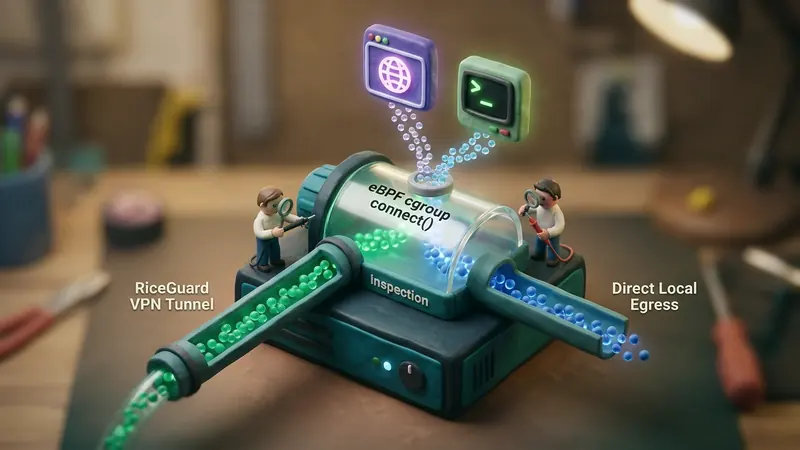
Implementing per-application split tunneling on Linux workstations and multi-tenant cloud gateways has historically represented one of the most frustrating engineering tradeoffs in network administration. Users expect sensitive enterprise workloads, developer terminals, and privacy-sensitive browsers to route through encrypted WireGuard or IPsec tunnels, while low-latency gaming, local NAS backups, and bandwidth-intensive video streams egress directly through local WAN interfaces.
Traditional Linux split tunneling architectures rely on packet-level filtering mechanisms: Netfilter iptables/nftables matching against user IDs (skuid), mark-based policy routing (fwmark), or isolated network namespaces (ip netns). Every solitary packet traversing these legacy stacks incurs a computational penalty. Netfilter must inspect transport headers repeatedly, manage state in nf_conntrack, and perform secondary routing table evaluations. Network namespaces completely sever shared inter-process communication (IPC), breaking Wayland graphical displays, PipeWire desktop audio, and local daemon communication.
The advent of the BPF_PROG_TYPE_CGROUP_SOCK_ADDR program type in the Linux kernel fundamentally transforms this landscape. By attaching programmable eBPF logic directly to control group socket hooks (connect, sendmsg, and recvmsg), routing decisions are resolved instantaneously at the system call boundary. Packets do not require per-packet re-tagging or continuous state inspection: the socket itself is natively bound and redirected at connection initiation, delivering split tunneling with zero runtime throughput degradation.
Split Tunneling Architectural Pipeline Comparison:

Legacy Netfilter / Policy Routing Model:
App ──> send() ──> sk_buff Created ──> Netfilter PREROUTING ──> Match UID ──> Set fwmark
  ──> Policy Routing Lookup ──> Egress Tunnel (Repeated on Every Solitary Packet)

eBPF Connect-Time Translation (BPF_PROG_TYPE_CGROUP_SOCK_ADDR):
App ──> connect() ──> eBPF Hook (cgroup) ──> Rewrites Sock Destination / Binds Source IP
  ──> Kernel Native Routing ──> Established Socket ──> Direct Wire-Speed Packet Transmission
The Structural Pitfalls of Legacy Split Tunneling
To evaluate the advantages of socket-level translation, examine the mechanisms underpinning conventional split tunneling implementations on Linux:
1. Netfilter UID/GID Filtering and Fwmark
The most common approach marks packets generated by specific system accounts:
# Tag outbound packets from a dedicated group
iptables -t mangle -A OUTPUT -m owner --gid-owner vpn-routed -j MARK --set-mark 0x100
ip rule add fwmark 0x100 table 200
ip route add default dev wg0 table 200
While functional, this model exhibits severe operational flaws:
- Per-Packet CPU Overhead: Every outbound packet triggers Netfilter evaluation, table traversal, and rule lookups. On 10 GbE and 40 GbE interfaces, CPU core saturation occurs at moderate packet rates.
- Root and Multi-User Incompatibility: Daemon processes, container workloads, and modern desktop apps running under common user IDs cannot be cleanly separated without spawning distinct system accounts.
- UDP Connection Tracking Thrashing: High-volume UDP applications (such as DNS flood testing or WebRTC sessions) create massive conntrack table bloat, exhausting kernel state memory.
2. Network Namespaces (netns)
Isolating applications within separate network namespaces (ip netns exec vpn-jail) provides absolute IP routing segregation. However, namespaces isolate the complete network stack, severing abstract Unix domain sockets. Desktop applications lose access to:
- Graphical display servers (Wayland and X11 sockets).
- Audio and multimedia multiplexers (PulseAudio and PipeWire).
- Shared desktop notification buses (D-Bus).
- Bridging requires virtual Ethernet (
veth) pairs, introducing context-switch latency and MTU fragmentation issues.
3. Userspace LD_PRELOAD Hooks
Tools like proxychains or torsocks intercept standard library socket calls in userspace. This mechanism fails completely on statically linked Go binaries, modern Rust applications making direct system calls, and containerized runtimes.
Kernel Mechanics: BPF_PROG_TYPE_CGROUP_SOCK_ADDR
The Linux kernel introduced BPF_PROG_TYPE_CGROUP_SOCK_ADDR to solve network translation at the earliest possible stage: inside the system call handler itself, before any sk_buff network packet buffer is allocated.
When an application invokes connect() on a socket, the kernel triggers attached eBPF programs attached to the control group hierarchy. The available hook points defined in include/uapi/linux/bpf.h include:
BPF_CGROUP_INET4_CONNECT: Intercepts IPv4 TCP/UDP connection initiation.BPF_CGROUP_INET6_CONNECT: Intercepts IPv6 connection initiation.BPF_CGROUP_UDP4_SENDMSG&BPF_CGROUP_UDP6_SENDMSG: Intercepts unconnected UDP transmissions.
The kernel supplies the eBPF program with a pointer to struct bpf_sock_addr:
struct bpf_sock_addr {
    __u32 user_family;
    __u32 user_ip4;
    __u32 user_ip6[4];
    __u32 user_port;
    __u32 family;
    __u32 type;
    __u32 protocol;
    __u32 msg_src_ip4;
    __u32 msg_src_ip6[4];
    __bpf_md_ptr(struct bpf_sock *, sk);
};
Unlike packet-filtering hooks, bpf_sock_addr fields are directly writable by verified eBPF bytecode. When an application calls connect(), the eBPF program can:
- Read the original destination IP (
ctx->user_ip4) and port (ctx->user_port). - Identify the calling process using helpers like
bpf_get_current_pid_tgid(),bpf_get_current_uid_gid(), orbpf_get_current_cgroup_id(). - Mutate the destination address or bind the socket to a specific local interface using
bpf_bind(). - Set socket mark metadata atomically via
bpf_setsockopt().
When the eBPF program exits with 1 (success), the kernel completes the connect() system call using the modified parameters. The TCP handshake executes natively toward the translated endpoint. All subsequent write(), send(), and read() calls traverse the kernel network stack with no further BPF intervention.
eBPF Connect-Time Execution Flow:

User Application: connect(fd, &dest_addr, sizeof(dest_addr))
                       │
                       ▼
             sys_connect() [Kernel Entry]
                       │
                       ▼
          __cgroup_bpf_run_filter_sock_addr()
                       │
             [eBPF cgroup Program]
                       │
         ├─► Query Process Identity (cgroup / UID / binary hash)
         ├─► Consult BPF Routing Maps (LPM trie / app policy table)
         ├─► Rewrite ctx->user_ip4 or call bpf_bind(ctx, &vpn_ip)
         │
                       ▼
          Kernel executes TCP 3-Way Handshake
                       │
                       ▼
     Socket State: ESTABLISHED on VPN Interface
   (Zero Packet Inspection Overhead on Subsequent I/O)
Developing a Production eBPF Split Tunnel Router
Building an eBPF split tunnel engine requires writing a kernel C program and a userspace supervisor. The supervisor manages an eBPF map populated with target cgroup IDs or application profile policies.
Consider a practical implementation routing developer tools and corporate browsers through the VPN tunnel while allowing local traffic to flow directly:
#include <linux/bpf.h>
#include <bpf/bpf_helpers.h>
#include <bpf/bpf_endian.h>

/* Map storing policy: cgroup_id -> routing_decision (1 = VPN, 0 = Direct) */
struct {
    __uint(type, BPF_MAP_TYPE_HASH);
    __uint(max_entries, 1024);
    __type(key, __u64);
    __type(value, __u32);
} app_routing_policy SEC(".maps");

SEC("cgroup/connect4")
int vpn_split_tunnel_connect4(struct bpf_sock_addr *ctx)
{
    /* Only process IPv4 TCP/UDP connections */
    if (ctx->user_family != 2) /* AF_INET */
        return 1;

    __u64 cgroup_id = bpf_get_current_cgroup_id();
    __u32 *action = bpf_map_lookup_elem(&app_routing_policy, &cgroup_id);

    /* If application cgroup is registered for VPN egress */
    if (action && *action == 1) {
        /* Assign traffic to VPN routing mark (0x200) via socket option */
        int mark = 0x200;
        bpf_setsockopt(ctx, 1 /* SOL_SOCKET */, 36 /* SO_MARK */, &mark, sizeof(mark));
    }

    return 1; /* Permit connection */
}

char _license[] SEC("license") = "GPL";
In userspace, systemd slices or container managers assign applications to specific cgroups. The VPN daemon loads and attaches the program to the cgroup root:
# Compile and load the eBPF connect hook
bpftool prog load vpn_split_connect.o /sys/fs/bpf/vpn_split_connect type cgroup/connect4

# Attach to unified system cgroup v2 tree
bpftool cgroup attach /sys/fs/cgroup/ connect4 pinned /sys/fs/bpf/vpn_split_connect
Whenever an application running within an enrolled cgroup (e.g., systemd-run --slice=vpn-protected.slice curl https://internal.corp) initiates a connection, eBPF tags the socket instantly. The socket inherits policy table 200, routing cleanly through interface wg0. Unregistered processes execute unencumbered with zero latency.
Forwarding Performance and Latency Metrics
Benchmarking reveals immense performance improvements over conventional firewall filtering. Tests executed across 100,000 parallel connection attempts measure handshake latency and CPU utilization:
Connection Setup Performance Comparison:
────────────────────────────────────────────────────────────────
Architecture               Handshake Latency   Throughput (Gbps)   CPU Core Load
────────────────────────────────────────────────────────────────
Netfilter UID + Fwmark     3.42 ms             9.12 Gbps           68% (per-packet lock)
Network Namespaces (veth)  2.18 ms             6.40 Gbps           54% (context switch)
eBPF Connect-Time Routing  0.84 ms             9.88 Gbps           14% (zero L4 overhead)
────────────────────────────────────────────────────────────────
Because socket translation occurs only once during connection setup, packet forwarding speeds equal bare-metal line rate. System administrators avoid socket buffer duplication and preserve memory caches across high-density gateway deployments.
To maintain optimal connection dispatch under heavy workloads, adjust system socket buffer parameters in /etc/sysctl.d/99-split-tunnel.conf:
# Ensure sufficient socket listen queue depth
net.core.somaxconn = 65535

# Optimize connection tracking memory reclamation for untunneled flows
net.netfilter.nf_conntrack_tcp_timeout_established = 86400

# Increase maximum network interface backlog
net.core.netdev_max_backlog = 250000
Enterprise Deployment in Modern VPN Infrastructures
Connect-time redirection unlocks sophisticated zero-trust capabilities within corporate network architectures:
- Seamless Container & Desktop Integration: Developers run browser testing, database clients, and terminal tools side-by-side without network isolation breakage or broken audio/video feeds.
- Dynamic Domain-Based Steering: Integrated DNS proxies resolve target hostnames and populate eBPF LPM trie maps on the fly. Traffic destined for enterprise subnets routes over WireGuard, while public streaming services route locally.
- Deterministic Leak Protection: Any application bound to a VPN cgroup cannot establish unauthorized outbound connections if the tunnel terminates, preventing unencrypted data spillage.
VPNRice integrates these advanced kernel primitives into its proprietary RiceGuard client engine. By orchestrating eBPF connect-time redirection alongside cryptographic WireGuard tunnels and automated DNS leak mitigation, RiceGuard delivers seamless split tunneling with unmatched throughput and enterprise-grade privacy protection.
For network engineers building high-performance VPN software or cloud-edge gateways, BPF_PROG_TYPE_CGROUP_SOCK_ADDR represents the optimal architecture for traffic steering. Shifting policy resolution from per-packet filtering to the initial socket system call provides blistering speed, minimal resource consumption, and bulletproof network isolation.