 Tiếng Việt
 English
 中文
 Español
 हिन्दी
 Français
 Português
 Русский
 Deutsch
 日本語
 한국어
 Italiano
 Bahasa Indonesia
 ไทย
 বাংলা
 ລາວ
 မြန်မာ
 العربية
 فارسی
 اردو
 Українська
 Română
 Azərbaycan
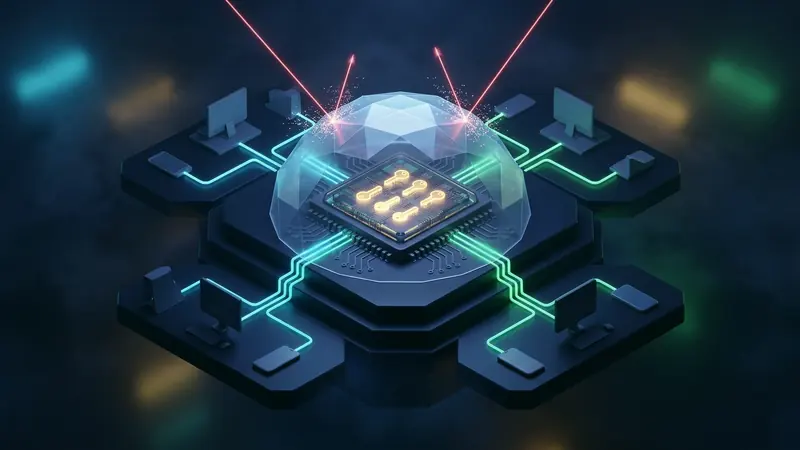
Virtual private networks serve as the primary security perimeter for remote workstations, mobile devices, and distributed enterprise nodes. Yet beneath the mathematical elegance of modern ciphers lies a persistent structural vulnerability: private key storage. In conventional VPN deployments, static private keys—whether WireGuard Curve25519 identity keys or IPsec private credentials—reside directly on persistent filesystems or sit unencrypted in host random-access memory (RAM).
If an attacker achieves local privilege escalation, executes infostealer malware, or conducts physical memory acquisition, software-only file permissions provide zero meaningful defense. Hardware-bound cryptography radically transforms this threat model. By anchoring cryptographic identity inside dedicated hardware security modules—such as Trusted Platform Module (TPM 2.0) chips, the Apple Secure Enclave, and Android StrongBox Keymaster—modern network stacks ensure that private key material never touches general-purpose memory or persistent storage.
The Vulnerability of Software-Stored VPN Private Keys
Standard operating system architectures trust processes based on user privileges and file access control lists. A standard WireGuard configuration stored in /etc/wireguard/wg0.conf or a Windows registry hive depends entirely on operating system permissions (such as chmod 0600 or NTFS Access Control Lists). Once an adversary elevates privileges to root or NT AUTHORITY\SYSTEM, these protections dissolve immediately.
Modern attack vectors regularly compromise software-bound keys:
- Infostealers and Credential Harvesters: Contemporary malware families specifically scan disk paths for VPN configuration profiles, private certificate bundles (
.p12,.pem), and process memory allocations containing cryptographic secrets. - Direct Memory Access (DMA) Exploits: Malicious or compromised peripherals connected via Thunderbolt, USB4, or PCIe buses can circumvent kernel protections and read host RAM directly, scraping cryptographic state during active tunnel sessions.
- Cold Boot Attacks: When physical possession is lost, memory retention characteristics allow attackers to chill RAM modules, reboot into an adversary-controlled operating system, and extract lingering private keys from memory banks.
- Kernel-Level Exploitation: Zero-day vulnerabilities in kernel drivers grant arbitrary memory read capabilities, allowing rootkits to extract ephemeral handshake keys and static identities alike.
Once an adversary acquires a static private key, the compromise is silent and catastrophic. The attacker can decrypt captured traffic sessions (unless protected by ephemeral key exchanges), impersonate the authenticated endpoint, and establish unauthorized connections across internal network segments.
Hardware Roots of Trust: TPM 2.0, Secure Enclave, and StrongBox
To eliminate memory-scraping vulnerabilities, modern computing platforms integrate dedicated hardware security microcontrollers designed specifically for isolated cryptographic execution.
+-----------------------------------------------------------------------+
|                          Host Operating System                        |
|                                                                       |
|   +-----------------------+               +-----------------------+   |
|   |   VPN Client Engine   |               |   Host RAM (DRAM)     |   |
|   |  (TUN/TAP Interface)  |               | (Only Public Data &   |   |
|   +-----------┬-----------+               |  Ephemeral Sessions)  |   |
|               │                           +-----------------------+   |
+───────────────┼───────────────────────────────────────────────────────+
                │ Command / Response Interface (PKCS#11, CNG, CryptoKit)
                ▼
+───────────────────────────────────────────────────────────────────────+
|               Hardware Security Boundary (Isolated Silicon)           |
|                                                                       |
|   +-----------------------+               +-----------------------+   |
|   | Hardware Cryptographic|               | Non-Volatile Secure   |   |
|   | Engine (AES/ECC/RSA)  | ◄───────────► | Storage (Private Key  |   |
|   +-----------------------+               | Never Leaves Silicon) |   |
|   | True Random Generator |               +-----------------------+   |
|   +-----------------------+                                           |
+-----------------------------------------------------------------------+
Three foundational implementations power hardware-bound security across platforms:
- TPM 2.0 (Trusted Platform Module): Standardized by the Trusted Computing Group (ISO/IEC 11889), TPM 2.0 is an independent cryptographic processor soldered directly onto motherboards or implemented inside dedicated CPU security firmware (fTPM). The TPM contains an immutable Endorsement Key (EK), secure non-volatile memory, and Platform Configuration Registers (PCRs) that record platform state during boot.
- Apple Secure Enclave (SEP): Built into Apple silicon (M-series and A-series chips), the Secure Enclave is a standalone system-on-chip coprocessor featuring its own secure boot ROM, dedicated memory management unit (MMU), hardware AES accelerator, and isolated encrypted memory bus. The main application processor communicates with the Secure Enclave strictly through a hardware-enforced mailbox interface.
- Android Keystore and StrongBox: Android implements hardware-backed cryptography through the Hardware Abstraction Layer (HAL). High-security Android devices incorporate StrongBox Keymaster—a physically separate tamper-resistant hardware microcontroller with dedicated CPU, secure storage, and true random number generation.
Cryptographic Key Isolation: Processing Without Exposure
The core architectural paradigm of hardware-bound security is simple: raw private keys are generated inside the secure silicon boundary and designated as non-exportable.
When a VPN client initializes a hardware-backed key pair, the host CPU instructs the secure coprocessor to generate the keys internally. The coprocessor returns the public key to the operating system, but the corresponding private key remains sealed within tamper-resistant non-volatile memory or wrapped with a hardware root key that only the coprocessor can decrypt.
During cryptographic handshakes:
- The VPN client receives a cryptographic challenge or peer public key from the remote server.
- The host passes this challenge into the secure coprocessor via high-level cryptographic APIs (such as Microsoft Cryptography Next Generation on Windows, PKCS#11 on Linux, or CryptoKit on macOS/iOS).
- The secure coprocessor executes the private key operation—such as Elliptic Curve Diffie-Hellman (ECDH) shared secret computation or digital signature generation (ECDSA/Ed25519)—directly on-chip.
- The coprocessor returns only the computed result (the derived secret or signature) to the host operating system.
Because the private key never traverses host memory buses or process address spaces, memory dump tools, kernel debuggers, and infostealers find nothing to extract.
Remote Attestation and Boot Integrity Verification
Hardware security modules provide an additional layer of defense critical for Zero Trust architectures: cryptographic platform attestation.
Through Platform Configuration Registers (PCRs), TPM 2.0 monitors each phase of system initialization, hashing UEFI firmware, bootloaders, kernel drivers, and system configurations. If an adversary installs a persistent rootkit or replaces kernel modules, the resulting PCR measurements diverge from expected values.
Modern enterprise VPN architectures use this integrity chain to enforce conditional access:
- Sealed Storage: VPN private keys can be cryptographically sealed to specific PCR measurements. If the system boots with an altered kernel or disabled Secure Boot, the TPM refuses to unseal or activate the private key.
- Attestation Quotes: During tunnel establishment, the client presents an attestation quote cryptographically signed by the TPM's Attestation Identity Key (AIK). The VPN gateway verifies the hardware quote against trusted reference measurements before permitting traffic through the tunnel.
Bridging Hardware Isolation with WireGuard and Modern Layer 3 VPNs
Integrating hardware-bound keys into lightweight Layer 3 protocols presents distinct engineering considerations. WireGuard utilizes the Noise IK handshake pattern, which relies on static Curve25519 Diffie-Hellman operations for mutual peer authentication.
Because early TPM 2.0 revisions and older hardware modules were optimized primarily for RSA and NIST P-256 curves, adapting modern Edwards-curve cryptography required architectural evolution:
- Hardware Algorithm Support: Modern TPM 2.0 revisions (supporting ECC Curve25519) and Apple Secure Enclave (supporting Ed25519 and P-256) now allow native curve operations directly inside secure silicon.
- Hybrid Handshake Architecture: In environments where hardware modules do not natively support Curve25519, systems utilize a hybrid authentication model. Initial mutual identity authentication is anchored to a hardware-protected P-256 or RSA key pair via PKCS#11/CNG. Once identity and platform attestation are confirmed, the tunnel establishes ephemeral session keys for the high-speed kernel data plane.
- Hardware Biometric Authorization: On mobile platforms, Android Keystore and Apple Secure Enclave can require cryptographic user presence (such as Touch ID, Face ID, or biometric enrollment) before authorizing the coprocessor to sign or compute handshake secrets.
Hardened Key Protection in VPNRice Architecture
Safeguarding user identity across complex threat landscapes requires security controls that extend from the physical silicon up to the network interface. VPNRice incorporates defense-in-depth principles across every platform layer.
VPNRice interfaces directly with platform-native security frameworks—utilizing macOS Keychain Services backed by the Secure Enclave, Windows CNG protected by TPM 2.0, and Android hardware-backed Keystore. Client authentication tokens and session credentials remain shielded from memory extraction through strict ephemeral session scoping and rapid memory zeroization routines. By isolating critical identity assets behind hardware-verified boundaries, VPNRice provides robust, leak-free privacy across all your devices. Get VPNRice.