Tiếng Việt
 English
 中文
 Español
 हिन्दी
 Français
 Português
 Русский
 Deutsch
 日本語
 한국어
 Italiano
 Bahasa Indonesia
 ไทย
 বাংলা
 ລາວ
 မြန်မာ
 العربية
 فارسی
 اردو
 Українська
 Română
 Azərbaycan
Modern enterprise engineering teams rely heavily on cloud-hosted software, distributed infrastructure, and global software-as-a-service (SaaS) platforms. Development workflows depend on rapid Git pushes to GitHub, continuous integration pipelines deployed on AWS and Google Cloud, real-time collaboration over Slack, and video conferencing via Zoom and Microsoft Teams. When international network connections operate normally, cross-border packets transit deep-sea optical fiber systems at light speed with minimal round-trip time (RTT).
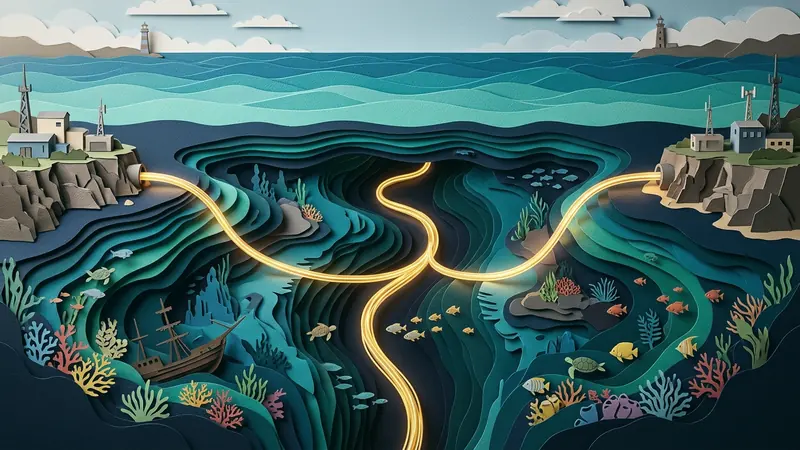
However, in coastal emerging hubs and across Southeast Asian corridors such as Vietnam, international connectivity relies on a fragile web of undersea cables—notably the Asia-America Gateway (AAG), Asia Pacific Gateway (APG), Intra-Asia (IA), and Asia-Africa-Europe 1 (AAE-1). When marine geological shifts, deep-sea dredging, or commercial ship anchors sever multiple cable branches simultaneously, international data transit collapses. Local Internet Service Providers (ISPs) scramble to rebalance immense bandwidth demands across remaining overland routes, triggering widespread packet loss, severe jitter, and broken TCP sessions.
Understanding why standard troubleshooting methods fail during major cable outages requires analyzing the underlying Border Gateway Protocol (BGP) dynamics and physical routing constraints.
The Anatomy of Subsea Cable Outages and BGP Convergence Shock
Undersea telecommunication cables consist of fragile hair-thin optical glass fibers encased in steel wire, copper power conductors, and waterproof polyethylene sheathing. Despite heavy armoring near shorelines, the ocean floor remains an unpredictable physical environment.
+-------------------------------------------------------------------------+
|                  Local Enterprise / Remote Developer                    |
+------------------------------------+------------------------------------+
                                     |
                                     v
+-------------------------------------------------------------------------+
|                     Domestic Tier-2 ISP Network                         |
|   * Upstream Cable Outage (AAG / APG / IA Severed)                      |
|   * Saturated Domestic Landlines & Terrestrial Transit Gateways         |
+-------------------+---------------------------------+-------------------+
                    |                                 |
     Failover Path  | Saturated (25% Drop)            | Dedicated Backhaul
                    v                                 v
+-----------------------------------+   +---------------------------------+
| Congested Public Transit Corridors|   | Private DWDM Transit Tunnel     |
| * BGP Route Flapping & High Buffer|   | * RiceGuard Anycast L3 Gateway  |
| * Severe Packet Loss / Reset Sockets| | * Deterministic Forwarding      |
+-------------------+---------------+   +----------------+----------------+
                    |                                    |
                    +-----------------+------------------+
                                      |
                                      v
+-------------------------------------------------------------------------+
|           Global Cloud Destinations (AWS, GCP, GitHub, Zoom)            |
+-------------------------------------------------------------------------+
1. Physical Cable Ruptures and Shunt Faults
Submarine cable failures typically fall into two categories:
- Complete Mechanical Cuts: Often caused by heavy commercial fishing trawlers dragging bottom nets or container ships dragging anchors during severe storms. A physical severance halts 100% of optical signal propagation across all fiber pairs within the cable sheath.
- Shunt Faults and Insulation Breaches: Saltwater penetrates the outer polyethylene jacket and contacts the internal copper high-voltage conductor that powers optical amplifiers (repeaters) along the seabed. While some data transmission may continue intermittently, signal-to-noise ratios degrade sharply, generating cyclic bit errors and hardware framing resets.
2. BGP Flapping and the Illusion of DNS Switching
A common misconception among end users and IT administrators during international network slowdowns is that changing local Domain Name System (DNS) resolvers—such as pointing to 8.8.8.8 or 1.1.1.1—will resolve connectivity problems.
DNS merely translates human-readable hostnames into IP addresses. It does not dictate how IP datagrams navigate physical telecommunication infrastructure. When an undersea cable breaks:
- Upstream border routers send BGP
WITHDRAWmessages to adjacent Autonomous Systems (ASNs), tearing down active routing prefixes. - Tier-1 and Tier-2 carrier edge routers execute path recomputation across remaining terrestrial cables (such as overland links through mainland China or secondary southern maritime routes).
- Because hundreds of gigabits of bandwidth are suddenly forced into terrestrial conduits with a fraction of the original capacity, intermediate router buffers overflow instantaneously.
- The resulting buffer exhaustion triggers tail-drop packet loss, causing round-trip latency to spike from 35 ms to over 350 ms, accompanied by 15% to 30% persistent packet drop.
3. TCP Congestion Collapse in Remote Workflows
Standard TCP congestion control algorithms (such as Cubic or Reno) interpret dropped packets as evidence of local link congestion. When a developer pushes code to an external repository or streams a team video call during an outage:
- Frequent packet drops force the TCP sender into aggressive congestion window reduction (halving the congestion window size
cwnd). - The sender halts data transmission while waiting for selective acknowledgments (SACK), causing throughput to plummet from 100 Mbps to less than 500 Kbps.
- Long-lived enterprise sessions, including SSH bastion tunnels and database replication streams, encounter retransmission timeouts (RTO) and disconnect entirely.
Engineering Resilience: Anycast Layer 3 Tunnels and Private Transit
Resolving international network degradation requires diverting application packets away from congested public transit queues into deterministic, privately engineered routing corridors.
Client Workstation [Dev / SaaS User]
         |
         v
[Virtual TUN Interface] ---> Hardware-Accelerated ChaCha20-Poly1305 Tunnel
                                         |
                                         v
                         Direct Terrestrial Dedicated Backhaul
                                         |
                                         v
                         Regional Tier-1 Anycast PoP (Singapore / HK)
                                         |
                                         v
                         Global Cloud & SaaS Data Centers
1. Dedicated Leased Line Backhaul (Private IP Transit)
While public commercial ISPs must balance millions of residential subscribers across overloaded backup routes, enterprise network providers maintain pre-reserved, non-shared capacity on diverse fiber systems, including inland terrestrial Dense Wavelength Division Multiplexing (DWDM) corridors.
Deploying RiceGuard allows remote workers and enterprise nodes to route outbound datagrams into a dedicated point of presence (PoP). Instead of competing with consumer streaming traffic on saturated public links, traffic enters high-priority Layer 3 tunnels that terminate directly inside major regional telecommunication hubs such as Singapore, Hong Kong, or Tokyo.
2. Multipath Packet Aggregation and UDP Forward Error Correction
Modern VPN architectures operating on Layer 3 encapsulation avoid traditional TCP-over-TCP congestion pitfalls. When operating in challenging network conditions:
- RiceGuard encapsulates client packets inside lightweight UDP datagrams. Unlike TCP streams that stall during packet loss, UDP transport permits forward error correction (FEC) and immediate recovery.
- Multipath routing protocols monitor packet delay variation (jitter) and dynamically steer datagrams across the lowest-latency physical interface, maintaining consistent throughput even when local carriers alter transit paths.
3. Protection Against Route Hijacking and Accidental Blackholes
During emergency rerouting events, telecommunication carriers frequently modify complex BGP prefix filters under tight time constraints. Configuration errors—such as accidental route leaks or sub-optimal transit announcements—can redirect traffic through circuitous paths across Europe or North America before reaching regional Asian destinations.
By terminating local sessions into an authenticated VPNRice tunnel, the client establishes an encrypted point-to-point association with an Anycast edge router. The enterprise's traffic is insulated from public BGP route instability, guaranteeing direct access to cloud resources.
Operational Checklist for Developers During Cable Maintenance
When regional subsea cable maintenance or unexpected cable cuts are announced, technical organizations should implement the following steps:
- Activate Layer 3 Tunneling: Establish an encrypted tunnel via VPNRice to divert developer traffic away from overloaded residential ISP transit routes.
- Optimize SSH and Git Settings: Configure
ServerAliveInterval 15andServerAliveCountMax 3in~/.ssh/configto prevent remote sessions from dropping during transient route reconvergences. - Audit Cloud Region Latencies: Run traceroutes to your primary AWS, Azure, or GCP infrastructure endpoints to verify whether traffic is transiting direct regional nodes rather than high-latency trans-Pacific detours.
- Prioritize Real-Time Media Protocols: Ensure corporate collaboration tools utilize UDP-based WebRTC protocols with dynamic rate adaptation rather than fallback TCP encapsulation.
By combining deterministic private transit backhauls with resilient Layer 3 cryptographic encapsulation, development teams can sustain reliable cloud operations, low-latency collaboration, and continuous productivity regardless of deep-sea infrastructure disruptions.