Tiếng Việt
 English
 中文
 Español
 हिन्दी
 Français
 Português
 Русский
 Deutsch
 日本語
 한국어
 Italiano
 Bahasa Indonesia
 ไทย
 বাংলা
 ລາວ
 မြန်မာ
 العربية
 فارسی
 اردو
 Українська
 Română
 Azərbaycan
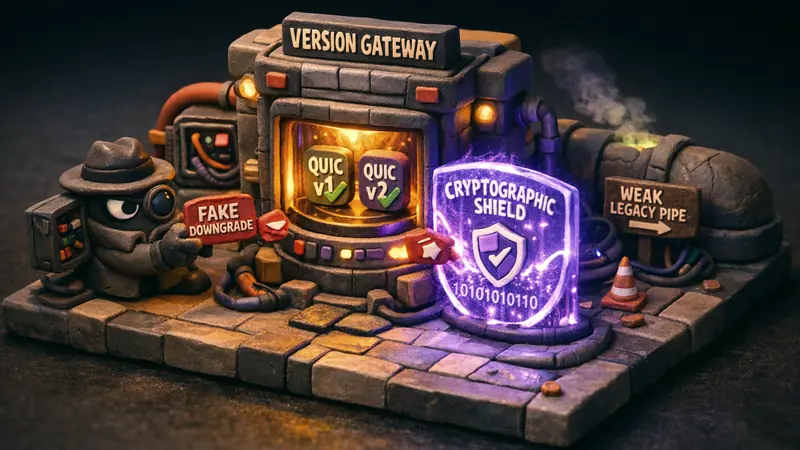
Transport protocol transitions on the public internet historically faced severe operational barriers. When a protocol introduces security updates, performance optimizations, or architectural revisions, communicating endpoints must negotiate which version to speak without knowing in advance what the other party supports. In legacy networking, this initial negotiation occurred entirely in plaintext, exposing connections to active man-in-the-middle tampering.
A prime vulnerability in unauthenticated version negotiation is the Downgrade Attack. An adversarial on-path middlebox—such as an inspection firewall, a rogue transit router, or an interception gateway—can intercept the initial connection packet and forge a response claiming that modern, secure versions are unsupported. The client, believing the remote peer lacks modern capabilities, reluctantly falls back to an obsolete, weak, or unencrypted protocol version where the attacker can inspect or manipulate data.
To permanently eliminate this attack vector from the next-generation transport stack, the Internet Engineering Task Force (IETF) standardized Compatible Version Negotiation for QUIC (RFC 9368) alongside QUIC Version 2 (RFC 9369). By binding version negotiation directly into the authenticated cryptographic handshake of TLS 1.3, QUIC ensures that any attempt by an intermediate adversary to force a version downgrade triggers an immediate cryptographic abort.
The Downgrade Attack Hazard: Transport Layer Historical Flaws
In early network protocols, version negotiation was treated as a mechanical handshake prerequisite rather than a cryptographic security boundary. For instance, in early SSL/TLS over TCP, an active attacker could forge a TCP RST or manipulate the ClientHello.client_version field, coercing the browser and server to fall back from TLS 1.2 to vulnerable SSL 3.0 (enabling the POODLE attack) or export-grade 512-bit ciphers (FREAK and Logjam attacks).
Legacy Plaintext Version Negotiation (Vulnerable to Active Downgrade):
Client ---[Initial Request: Propose Modern Protocol v2]---> (Attacker intercepts)
                                                                 |
Client <---[Forged Error: "v2 Not Supported, Try v1"]------ (Attacker injects)
Client ---[Fallback Request: Reconnect using Weaker v1]---> Server
Result: Attacker forces the connection onto a compromised or observable protocol!

RFC 9368 Cryptographically Authenticated Version Negotiation:
Client ---[Initial Packet (v1): Proposed versions cryptographically signed]---> Server
Client <---[Encrypted Handshake: Server authenticates chosen & available versions]<--- Server
Verification: Transcript Hash covers Version Information parameter!
Result: Any tampering on the wire results in immediate VERSION_NEGOTIATION_ERROR!
When QUIC v1 (RFC 9000) was standardized, it included an unauthenticated Version Negotiation packet sent by servers when an unknown 32-bit version tag was received. While RFC 9000 mitigated basic tampering, it lacked a formal framework for zero-round-trip version upgrading and cryptographically guaranteed downgrade prevention. RFC 9368 resolved this gap.
In-Flight Spoofing of Version Negotiation Packets by Hostile Middleboxes
Under RFC 9000, when a client transmits an Initial packet containing an unsupported version tag, the server responds with a special packet where the Version field is set to 0x00000000. The body of this packet lists all versions the server supports.
Because this packet is generated before any cryptographic keys are established, an active on-path adversary can readily forge it:
- Active Injection of Fake Version Lists: An adversarial middlebox monitoring UDP port 443 can inject a spoofed
0x00000000Version Negotiation packet containing only legacy or deprecated version numbers before the legitimate server response arrives. - Forced Downgrade to Broken Drafts: If a client naively respects this spoofed list, it restarts its connection using an insecure draft or legacy version where transport encryption is weaker or headers are unmasked.
- Denial of Service via Endless Loops: A middlebox could alternately inject contradictory version lists, forcing the client into infinite negotiation loops and preventing session establishment entirely.
RFC 9368 completely disarms these attacks by shifting version authenticity into the authenticated TLS 1.3 handshake.
Compatible Version Negotiation Architecture in RFC 9368
RFC 9368 establishes a clear taxonomy between two classes of protocol transitions:
- Incompatible Versions: Protocols with fundamentally different wire images, header invariants (RFC 8999), or cryptographic handshakes. Transitioning between incompatible versions requires a full restart using a new connection ID.
- Compatible Versions: Protocol versions that share common wire invariants, packet header formats, and TLS handshake structures (such as QUIC v1 and QUIC v2). Compatible versions can negotiate upgrades dynamically without restarting the handshake or incurring latency penalties.
/* Pseudocode: RFC 9368 Version Information Transport Parameter */
struct version_information {
    uint32_t chosen_version;        /* Version negotiated for this connection */
    uint32_t available_versions[];  /* Fully ordered array of versions supported */
};

/* Server-side validation of client version offer */
int validate_version_negotiation(const struct version_information *client_info,
                                 const struct version_information *server_info)
{
    /* 1. Ensure chosen_version matches the physical packet header version */
    if (client_info->chosen_version != current_packet_version()) {
        return ERR_VERSION_NEGOTIATION;
    }

    /* 2. Check if a more preferred mutual version was bypassed maliciously */
    uint32_t highest_mutual = find_highest_mutual_version(client_info->available_versions,
                                                          server_info->available_versions);
    if (client_info->chosen_version != highest_mutual && was_downgraded_by_middlebox()) {
        /* Active tampering detected: terminate connection immediately */
        return ERR_VERSION_NEGOTIATION;
    }

    return SUCCESS;
}
Cryptographic Verification via Version Information Transport Parameters
At the core of RFC 9368 lies the version_information transport parameter. During the TLS 1.3 handshake:
- Client Parameter Encapsulation: The client encodes its proposed
chosen_version(the version in the Initial packet header) and an array ofavailable_versionsthat its local stack supports into an encrypted TLS extension. - Server Verification and Mutual Selection: The server examines the client's
version_information. If the client and server both support a newer, more secure version (e.g., QUIC v2) that is compatible with the version used in the Initial packet (QUIC v1), the server can select the newer version immediately. - Cryptographic Sealing: The server replies with its own
version_informationparameter. Because all transport parameters are included in the TLS 1.3 Finished message and authenticated via the Transcript Hash (HMAC-SHA256orHMAC-SHA384), an on-path attacker cannot alter or strip any listed version without causing handshake cryptographic verification to fail.
If an attacker injected a fake Version Negotiation packet earlier in the flow, the client's reported history will conflict with the server's cryptographic expectation, instantly triggering a fatal VERSION_NEGOTIATION_ERROR close frame.
QUIC Version 2 (RFC 9369) Innovations and Middlebox Anti-Ossification
Standardized concurrently with RFC 9368, QUIC Version 2 (RFC 9369) was engineered specifically to exercise compatible version negotiation and prevent the ossification of intermediate middleboxes.
Network middleboxes frequently build hardcoded assumptions around fixed protocol constants—such as QUIC v1's HKDF salt (0x38762cf7f55934b34d179ae6a4c80cadccbb7f0a) or specific Long Header packet type numbers. If a second version were never deployed, network firewalls would eventually drop any packet that does not match QUIC v1's exact bit patterns.
Key Differences Between QUIC v1 (RFC 9000) and QUIC v2 (RFC 9369):
Feature                  QUIC v1 (RFC 9000)         QUIC v2 (RFC 9369)
----------------------------------------------------------------------------------
Version Tag              0x00000001                 0x6b3343cf
Initial Packet Type      0x00                       0x01
0-RTT Packet Type        0x01                       0x02
Handshake Packet Type    0x02                       0x03
Retry Packet Type        0x03                       0x00
Initial HKDF Salt        afc5be74... (RFC 9001)     0xa707f299... (RFC 9369)
Compatible with v1?      Yes                        Yes (via RFC 9368)
By intentionally rotating packet type identifiers and cryptographic salt values while preserving compatible handshake mechanics, RFC 9369 validated that endpoints can negotiate upgrades in production across global transit routes without middlebox interference.
Seamless 0-RTT Version Transition Without Handshake Resets
When a client initiates a connection using QUIC v1, it can indicate support for QUIC v2 in its available_versions array. Under RFC 9368:
- The server confirms the upgrade to QUIC v2 within the initial handshake response.
- Both endpoints switch their packet protection keys to the RFC 9369 key schedule starting from the Handshake cryptographic level.
- Application data begins transmitting under QUIC v2 immediately, achieving full version upgrade with zero additional round trips (0-RTT upgrade).
Architectural Implementation in RiceGuard and Core L3 VPN Tunnels
VPN overlays deployed in hostile network environments must defend against active protocol tampering, active probing, and forced fallback attacks. VPNRice incorporates RFC 9368 and RFC 9369 principles across its core infrastructure:
- Cryptographic Anti-Downgrade Invariants in RiceGuard: The RiceGuard protocol enforces strict transcript-authenticated version binding. If an adversarial middlebox on an untrusted Wi-Fi or transit network injects fraudulent negotiation frames, RiceGuard detects the transcript mismatch and aborts the session rather than permitting an insecure downgrade.
- Zero-Fallback Security Policy in Core L3 VPN: Enterprise site-to-site tunnels operate under a strict anti-tampering mandate. When intermediate network hops attempt to disrupt modern QUIC or RiceGuard framing, gateways refuse fallback to vulnerable, unauthenticated legacy transports, preserving end-to-end data integrity.
- Agile Protocol Modernization: By supporting compatible version negotiation natively, VPNRice gateways dynamically upgrade transport parameters across distributed server endpoints, ensuring continuous resistance against protocol ossification.
Summary: Enforcing Cryptographic Invariants Against Active Tampering
Compatible Version Negotiation (RFC 9368) and QUIC Version 2 (RFC 9369) solve a foundational challenge in modern internet engineering: allowing network protocols to evolve rapidly without leaving users vulnerable to active downgrade attacks.
By embedding version parameters directly within the authenticated TLS 1.3 handshake, modern networks eliminate the structural weaknesses that plagued legacy transport protocols. Experience resilient and privacy-first network connectivity across all your devices with Get VPNRice.\n