Tiếng Việt
 English
 中文
 Español
 हिन्दी
 Français
 Português
 Русский
 Deutsch
 日本語
 한국어
 Italiano
 Bahasa Indonesia
 ไทย
 বাংলা
 ລາວ
 မြန်မာ
 العربية
 فارسی
 اردو
 Українська
 Română
 Azərbaycan
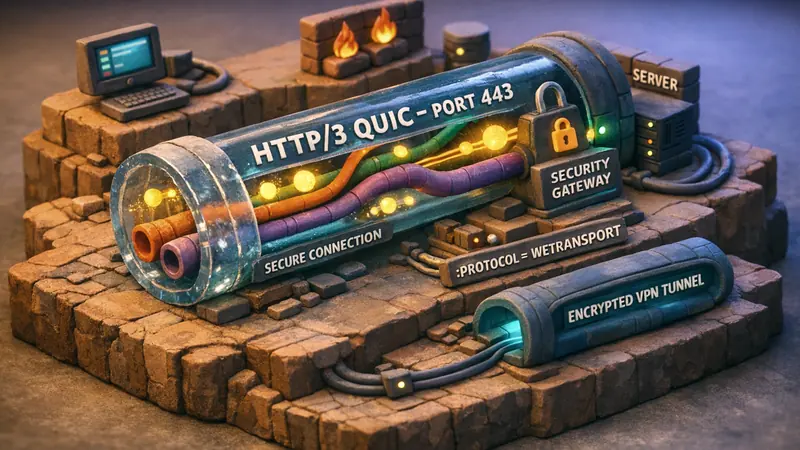
Tunneling private network traffic across hostile or heavily monitored perimeter firewalls has historically required difficult trade-offs between performance, detection risk, and protocol complexity. Conventional VPN implementations that rely on specialized UDP ports or static header formats are easily identified and throttled by Deep Packet Inspection (DPI) middleboxes. Conversely, encapsulating network tunnels inside legacy TCP connections introduces catastrophic Head-of-Line (HoL) blocking whenever transient packet loss occurs.
The arrival of HTTP/3 and QUIC fundamentally altered these constraints. Through RFC 9220—which defines the Extended CONNECT method for HTTP/3—network engineers gained the ability to bootstrap arbitrary bidirectional byte streams, multiplexed sub-protocols, and unreliable datagram sessions directly inside a single authenticated HTTP/3 session. Using QUIC’s stream independence, Extended CONNECT turns standard web traffic conduits into high-performance, censorship-resistant tunneling channels.
The Evolution from Classic CONNECT to Extended CONNECT
The classic HTTP CONNECT method was designed decades ago for plain TCP proxying. When an HTTP client issued a CONNECT host:port HTTP/1.1 request to a forward proxy, the proxy negotiated a raw TCP socket to the destination and handed the stream over to the client. While effective for simple HTTPS forwarding, this approach required a dedicated TCP connection for every distinct destination tunnel, introducing significant transport-layer handshake overhead and memory consumption.
With HTTP/2, RFC 8441 introduced Extended CONNECT. Instead of taking over the entire physical transport socket, Extended CONNECT transformed an individual HTTP/2 stream into a tunneled sub-protocol channel via the :protocol pseudo-header. However, because HTTP/2 remained bound to a single underlying TCP transport byte stream, any dropped IP packet stalled every multiplexed tunnel sharing that connection.
HTTP/3 RFC 9220 resolves this fundamental transport constraint. In HTTP/3, the entire protocol stack operates on top of QUIC over UDP. Each HTTP/3 request occupies a dedicated QUIC stream with independent cryptographic framing and autonomous loss recovery. When Extended CONNECT runs over HTTP/3, individual tunnels execute inside separate QUIC streams: if one tunnel experiences packet loss, every other parallel tunnel continues delivering payloads without experiencing a microsecond of transport delay.
The Architecture of RFC 9220: The :protocol Pseudo-Header and SETTINGS_ENABLE_CONNECT_PROTOCOL
To establish an Extended CONNECT session, the client and server engage in deterministic capability negotiation during the initial HTTP/3 parameter exchange. The server advertises its capability by including SETTINGS_ENABLE_CONNECT_PROTOCOL = 1 inside its initial HTTP/3 SETTINGS frame.
Once confirmed, the client initiates a tunnel by transmitting a HEADERS frame containing five mandatory pseudo-headers:
| Pseudo-Header Field | Assigned Protocol Value | Structural Role in Extended CONNECT Handshake |
|---|---|---|
:method |
CONNECT |
Signals request to establish an encapsulated protocol tunnel |
:protocol |
websocket, webtransport, etc. |
Declares intended tunneled sub-protocol within the stream |
:scheme |
https |
Specifies cryptographic transport protection context |
:authority |
Target FQDN and Port | Identifies authoritative server destination for authorization |
:path |
URI Path Component | Specifies target application endpoint or routing entry point |
When the server accepts the tunnel request, it returns an HTTP 200 OK response status code. From that instant, the QUIC stream transitions from an HTTP header exchange state into an end-to-end encapsulated data channel. The client and server exchange sub-protocol frames directly as payload bytes, superseding all traditional HTTP request-response syntax.
WebTransport over HTTP/3: Multiplexed Streams and Datagram Freedom
While RFC 9220 originally codified WebSocket bootstrapping over HTTP/3, its real architectural impact emerged through WebTransport. Developed collaboratively by the IETF and W3C, WebTransport establishes a generic transport framework inside HTTP/3 connections.
Through Extended CONNECT, an application initiates a WebTransport session by specifying :protocol = webtransport. Once active, the session serves as a parent container capable of spawning multiple distinct communication primitives inside the same QUIC connection:
- Bidirectional Streams: Reliable, flow-controlled, full-duplex byte streams for control messaging and interactive remote procedures.
- Unidirectional Streams: Independent send-only or receive-only data streams ideal for high-throughput data delivery.
- Unreliable Datagrams: Enabled via the QUIC DATAGRAM extension (RFC 9221), allowing the transmission of low-latency UDP packets without retransmission overhead.
This architectural flexibility bridges the gap between raw transport sockets and web-native APIs. A secure tunnel can multiplex real-time media, DNS queries, and bulk file downloads across a single authenticated port 443 connection without cross-stream interference.
Eradicating Head-of-Line Blocking at the Transport Layer
Head-of-Line blocking has historically plagued multiplexed virtual networks. When multiple application flows share a single TCP connection, TCP enforces strict byte ordering across the entire payload stream. If packet three arrives corrupted while packets four through ten arrive intact, TCP retains packets four through ten in receive buffers until packet three is retransmitted.
Under Extended CONNECT on HTTP/3, this structural flaw is eradicated:
- Per-Stream Flow Control: Each tunneled session maintains its own independent flow control credit, preventing a sluggish receiver from starving adjacent channels.
- Selective Acknowledgements: QUIC acknowledges packet numbers rather than byte offsets, allowing precise loss detection and localized retransmissions.
- Isolated State Machines: A retransmitted frame in stream A does not delay delivery of frames in stream B, preserving smooth latency curves for real-time services.
For mobile users navigating variable cellular connections, this isolation translates directly into responsive application behavior and predictable packet delivery times.
DPI Resistance: Camouflaging VPN Tunnels as Standard Web Traffic
Adversarial firewalls and enterprise inspection appliances routinely flag and block traditional tunneling protocols by examining packet header signatures, handshake sizes, and UDP port allocations. Protocols like OpenVPN or standard IPsec produce recognizable cryptographic metadata that deep packet inspection engines quickly classify.
Extended CONNECT over HTTP/3 provides structural DPI resistance. Because the tunnel initiation occurs entirely within standard HTTP/3 HEADERS frames encrypted by QUIC’s TLS 1.3 cryptographic layer, an on-path observer cannot distinguish between a user browsing a secure website and a user establishing an encrypted private network tunnel.
The connection uses standard UDP port 443, negotiates ALPN identifier h3, and presents standard TLS ClientHello structures. Even when traffic analysis middleboxes monitor packet timing and packet size distributions, the multiplexing of multiple independent sub-streams inside the same QUIC connection naturally scrambles packet length heuristics, frustrating machine learning classifiers.
Production Engineering in VPNRice RiceGuard
Within the VPNRice infrastructure, our research team harnessed RFC 9220 Extended CONNECT and WebTransport primitives to develop our next-generation web client and browser extension architecture. Integrated directly into the RiceGuard transport pipeline, this design brings kernel-grade privacy protections into restricted client runtimes.
When operating in environments where raw UDP socket creation is restricted by operating system sandboxes, RiceGuard automatically establishes an authenticated HTTP/3 Extended CONNECT session with our nearest Anycast edge node. Inside this encrypted wrapper, DNS queries, interactive application packets, and background sync traffic run across distinct QUIC sub-streams, fully immune to packet-in-packet retransmission spirals.
By uniting the cryptographic privacy of QUIC with the camouflage of HTTP/3 Extended CONNECT, VPNRice provides robust censorship resistance and seamless throughput across demanding network environments. Protect your communications with enterprise-grade engineering through Get VPNRice.