Tiếng Việt
 English
 中文
 Español
 हिन्दी
 Français
 Português
 Русский
 Deutsch
 日本語
 한국어
 Italiano
 Bahasa Indonesia
 ไทย
 বাংলা
 ລາວ
 မြန်မာ
 العربية
 فارسی
 اردو
 Українська
 Română
 Azərbaycan
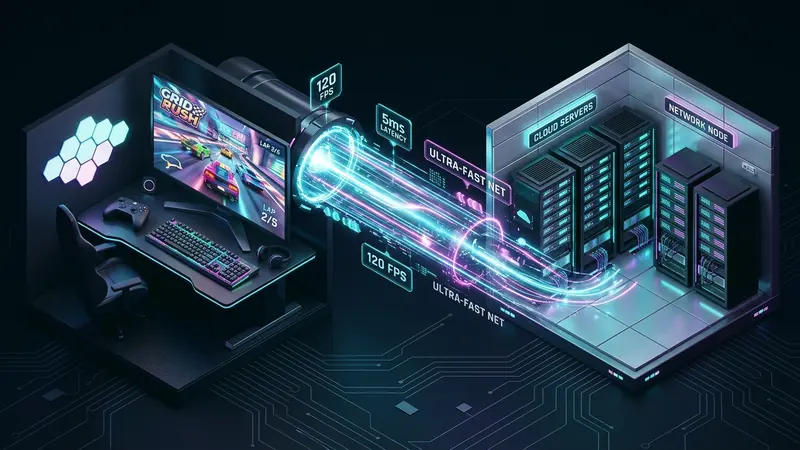
Cloud gaming platforms—including GeForce NOW, Xbox Cloud Gaming, PlayStation Cloud, and self-hosted streaming environments such as Moonlight and Sunshine—have redefined how players interact with hardware-intensive AAA titles. By offloading computational physics rendering and graphical shaders to remote server farms, users can transform standard office laptops, tablets, and smart televisions into high-performance gaming machines.
Unlike traditional software execution, cloud gaming performance is entirely bound to the physical and logical health of your network transit pipeline. Even on high-tier fiber subscriptions advertising hundreds of megabits per second, players frequently encounter input lag, macroblocking, tearing artifacts, and sudden frame drops.
The Zero-Buffer Pipeline Architecture of Real-Time Interactive Streaming
The technical requirements of interactive game streaming differ fundamentally from on-demand video streaming (such as Netflix or YouTube):
- Passive Video on Demand (VOD): Media players maintain large read-ahead buffers storing thirty to sixty seconds of future playback. When network jitter or temporary packet loss occurs, the buffer absorbs the anomaly, delivering seamless video playback without interruptions.
- Interactive Zero-Buffer Pipeline: Cloud gaming cannot buffer future frames because every single frame is rendered conditionally based on the player's immediate hardware inputs milliseconds earlier.
- Sub-16-Millisecond Round-Trip Time: The remote GPU cluster must capture input telemetry, compute world physics, encode the frame via dedicated silicon (such as NVENC or AV1 hardware encoders), packetize the bitstream into UDP datagrams, and transmit them across the public internet. To sustain 60 frames per second (FPS), this complete bidirectional loop must execute within 16.6 milliseconds. On high-refresh 120 FPS displays, the threshold tightens to 8.3 milliseconds.
When network round-trip time (RTT) spikes or fluctuates, input latency expands immediately. In competitive first-person shooters or fighting games, this discrepancy degrades target tracking, motor timing, and perceived control responsiveness.
Network Impediments: Jitter, Bufferbloat, and ISP Traffic Shaping
When an interactive game stream stutters, network engineers typically isolate three underlying transport pathologies:
1. UDP Packet Reordering and Jitter
Cloud gaming sessions demand sustained throughput ranging from 35 Mbps to 75 Mbps over UDP. On unoptimized consumer broadband routes, transient congestion across internet peering points causes UDP datagrams to arrive out of order or drop entirely. Because the client hardware decoder cannot render predictive P-frames without corresponding reference data, packet loss results in severe visual pixelation or total video freezes.
2. Router Bufferbloat Under Concurrent Network Load
In typical residential networks, multi-device usage frequently overwhelms consumer router buffers. When another device initiates a background download or cloud backup, intermediate queues fill to capacity. This bufferbloat causes round-trip latency to surge from 15 milliseconds to over 150 milliseconds in bursts, destroying interactive game responsiveness.
3. Deep Packet Inspection (DPI) Throttling by ISPs
Broadband internet service providers actively deploy Deep Packet Inspection (DPI) middleboxes to regulate transit bandwidth during peak evening hours. Sustained high-bitrate UDP traffic patterns are frequently misclassified by automated QoS heuristics as peer-to-peer file transfers. In response, upstream shapers deprioritize the connection, causing sudden bitrate degradation and resolution drops.
Optimizing Interactive Throughput with RiceGuard Layer 3 Architecture
VPNRice addresses these systemic networking bottlenecks through its kernel-level WireGuard implementation and specialized Layer 3 routing design:
- Uniform ChaCha20-Poly1305 Encapsulation: WireGuard encapsulates all video datagrams, controller input telemetry, and audio streams inside uniform UDP packets. Because middlebox DPI engines cannot inspect payload headers or identify streaming protocol signatures, ISP automated traffic-shaping rules are rendered completely ineffective.
- Direct BGP Anycast Peering: Rather than subjecting traffic to convoluted, congested international transit paths chosen by retail ISPs, VPNRice routes connections through tier-1 internet exchange points (IXPs) located immediately adjacent to major cloud gaming server facilities. This architecture minimizes hop counts and maintains stable round-trip times.
- Kernel-Space Processing Efficiency: Operating entirely within the operating system kernel space, WireGuard eliminates userspace context-switching penalties. This ensures immediate packet processing without CPU scheduling delays, stabilizing frame delivery intervals for consistent 60 and 120 FPS performance.
Practical Configuration Checklist for Ultra-Low Latency Gameplay
To establish an optimal networking environment for cloud gaming:
- Establish Wired Gigabit Ethernet Connectivity: Avoid the 2.4 GHz and congested 5 GHz Wi-Fi spectrums, which are prone to electromagnetic interference and radio packet retries. A physical Cat6 Ethernet cable eliminates local radio jitter entirely.
- Select the Closest VPN Gateway to the Gaming Datacenter: Connect to a VPN server situated in the same metropolitan area or network hub hosting the cloud gaming infrastructure to maintain minimal physical transit distance.
- Configure MTU Values to Prevent UDP Fragmentation: Set your VPN network adapter MTU between 1280 and 1420 bytes, preventing nested packet fragmentation across intermediate PPPoE or mobile broadband boundaries.
- Implement Application-Level Split Tunneling: Configure your VPN client to route dedicated cloud gaming binaries or browser sessions through the accelerated tunnel while permitting local background applications to operate unimpeded.
Implementing rigorous network routing principles eliminates the barrier between cloud data centers and local displays, unlocking pristine interactive visuals and responsive competitive control.