Tiếng Việt
 English
 中文
 Español
 हिन्दी
 Français
 Português
 Русский
 Deutsch
 日本語
 한국어
 Italiano
 Bahasa Indonesia
 ไทย
 বাংলা
 ລາວ
 မြန်မာ
 العربية
 فارسی
 اردو
 Українська
 Română
 Azərbaycan
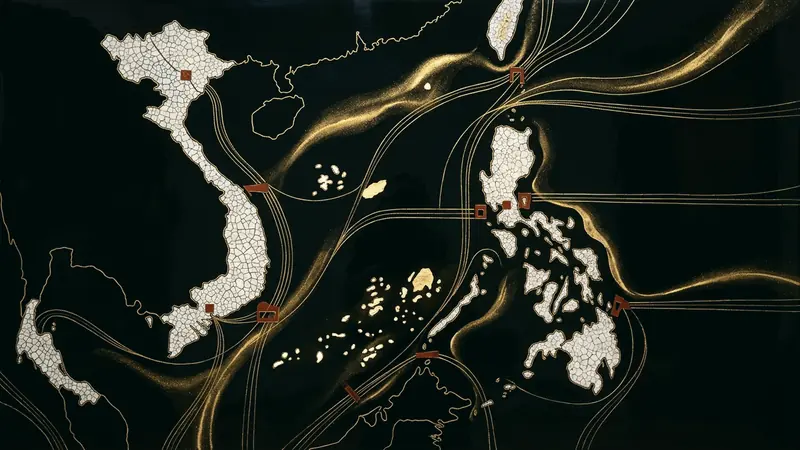
Software engineering teams, real-time financial traders, and competitive gamers operating in Vietnam frequently observe puzzling network behavior. While physical submarine fiber cables directly link coastal landing stations in Da Nang, Quy Nhon, and Vung Tau to Singapore with round-trip times (RTT) under 32 milliseconds, real-world ping to AWS (ap-southeast-1), Google Cloud (asia-southeast1), or regional SaaS endpoints routinely surges beyond 140 milliseconds during peak business hours.
This performance degradation is rarely caused by local fiber breaks alone. Instead, it stems from Border Gateway Protocol (BGP) asymmetric routing across domestic autonomous systems (ASNs) and their upstream Tier 1 transit providers. When outbound and inbound packets traverse entirely different geographic paths across Southeast Asia and the Pacific, latency explodes, jitter escalates, and TCP congestion control mechanisms throttle throughput. Understanding this architectural defect allows network administrators to deploy dedicated Layer 3 VPN transit tunnels that enforce strict path symmetry and stabilize latency.
The Anatomy of BGP Hot-Potato Routing in Vietnam ISPs
Vietnam hosts several major telecommunications providers operating their own autonomous systems, including VNPT (AS45899), Viettel (AS7552), FPT Telecom (AS18403), and CMC Telecom (AS24086). While domestic traffic exchanges efficiently through the Vietnam Internet eXchange (VNIX), cross-border packets rely on a combination of consortium-owned submarine cables (such as APG, AAG, IA, and AAE-1) and commercial IP transit agreements.
Under standard BGP path selection defined in RFC 4271, routers determine the optimal path based on attributes including Local Preference, AS Path length, Origin type, and Multi-Exit Discriminator (MED). However, financial considerations heavily influence how commercial autonomous systems configure these attributes. Most Tier 2 and Tier 3 providers implement "hot-potato routing": an operational strategy where an ISP hands off outbound packets to an upstream transit network as quickly as possible to minimize transit costs across its own infrastructure.
flowchart TD
    subgraph ClientSide["Client Environment (Vietnam)"]
        Workstation["Developer Workstation / Gaming Client"]
        LocalRouter["Domestic Fiber Router (VNPT / Viettel / FPT)"]
        Workstation --> LocalRouter
    end

    subgraph OutboundPath["Outbound Path (Direct Cable: ~32ms)"]
        LocalRouter -->|Direct Subsea Cable APG/AAE-1| SingaporeDC["Equinix SG1 / Global Switch (Singapore)"]
    end

    subgraph InboundPath["Asymmetric Return Path (Tromboning: ~145ms)"]
        SingaporeDC -->|Upstream Tier 1 Cogent / Telstra| TransitHK["Hong Kong Exchange (HKIX)"]
        TransitHK -->|Pacific Circuit| TransitTokyo["Tokyo Peering Point"]
        TransitTokyo -->|Trans-Pacific Reroute| TransitUS["US West Coast Transit"]
        TransitUS -->|Congested Trans-Pacific Return| LocalRouter
    end

    SingaporeDC -.-> CloudApp["Target AWS ap-southeast-1 / Cloud API"]
Consider a developer in Ho Chi Minh City sending a TCP SYN packet to an API endpoint hosted in an AWS Singapore availability zone:
- Outbound traversal: The domestic ISP routes the packet through its direct capacity on the Asia-Pacific Gateway (APG) or AAE-1 subsea cable straight into Singapore. The packet arrives at the destination in approximately 30 milliseconds.
- Inbound return: The destination cloud provider or intermediate transit network looks up the route back to the developer's public IP prefix. Because the domestic ISP may advertise its prefix through cheaper global transit partners (such as Cogent AS174, Tata Communications AS6453, or Telstra AS4637) without strict MED coordination, the return packet gets injected into a circuitous route.
- The tromboning effect: Return packets may travel from Singapore to Hong Kong, hop across subsea links to Tokyo, route through the US West Coast, and finally re-enter Vietnam through an alternate transit link.
The resulting round-trip measurement reveals an asymmetric delta: 30ms outbound, 115ms inbound, yielding a total RTT of 145ms.
Technical Consequences of Path Asymmetry on Transport Protocols
Asymmetric routing impairs interactive digital workflows far beyond simple ping inflation. Its secondary impacts severely degrade transport-layer performance:
1. Spurious TCP Retransmissions and Window Collapses
Modern TCP congestion control algorithms (such as CUBIC and BBR) rely on consistent acknowledgment (ACK) timing to gauge available bandwidth. In asymmetric conditions, variable queue depths on the return path induce ACK jitter. If an ACK packet arrives after the sender's retransmission timeout (RTO) expires, the sending host assumes packet loss, shrinks its congestion window (cwnd) to 1 MSS, and halves transmission throughput.
2. Stateful Firewall State Table Desynchronization
Enterprise perimeter defenses and stateful inspection firewalls expect to observe both sides of a bidirectional TCP three-way handshake (SYN, SYN-ACK, ACK). When return packets miss the ingress interface where the session state was originally recorded, intermediate security gateways drop the packets as unsolicited out-of-state traffic, causing random session disconnects in SSH, database replication, and VPN tunnels.
3. Asymmetric MTU Mismatches and Path MTU Discovery Failures
Different transit providers configure distinct Maximum Transmission Unit (MTU) sizes across their backbone infrastructure. If the outbound path supports standard 1500-byte frames but the convoluted return path enforces a 1480-byte or 1420-byte ceiling due to tunneling overhead, Path MTU Discovery (PMTUD) packets (ICMP Type 3, Code 4 "Fragmentation Needed") may be dropped by transit routers that filter ICMP. This produces a "black hole" connection where small packets pass effortlessly, but large HTTPS payloads hang indefinitely.
Enforcing Path Symmetry via Layer 3 VPN Architecture
Resolving ISP-level BGP routing policies requires multi-million dollar direct peering agreements that are out of reach for individual branches and distributed teams. However, network architects can reliably overcome this limitation by deploying a dedicated Layer 3 VPN transit bridge anchored in a Tier 4 datacenter in Singapore.
By establishing an encrypted WireGuard or IPsec tunnel directly from the client's gateway in Vietnam to a Singapore VPN gateway, the routing topology is fundamentally restructured:
flowchart LR
    subgraph Branch["Vietnam Office / Branch Gateway"]
        LocalHost["Workstation (Vietnam)"]
        TunnelClient["VPN Client Gateway"]
        LocalHost --> TunnelClient
    end

    subgraph EncryptedTransit["Encrypted L3 WireGuard Tunnel"]
        TunnelClient ==>|Symmetric UDP Encapsulation| VPNGateway["VPNRice Singapore Edge (Equinix SG1)"]
    end

    subgraph DestinationCloud["Regional Cloud Infrastructure"]
        VPNGateway -->|Direct Local BGP Peering < 2ms| AWSSG["AWS ap-southeast-1"]
        VPNGateway -->|Direct Cross-Connect < 1ms| GCPSG["GCP asia-southeast1"]
    end

    AWSSG -->|Local Return Traffic| VPNGateway
    VPNGateway ==>|Symmetric Encapsulated Return| TunnelClient
When client packets enter the VPN interface:
- The client wraps the original IP packet inside an outer UDP datagram addressed exclusively to the VPN gateway in Singapore.
- Because the domestic ISP maintains a single deterministic route to the VPN gateway's static public IP, outbound encapsulation flows straight through direct submarine fiber.
- Upon arrival in Singapore, the VPN gateway decapsulates the packet and transmits it to AWS or GCP via local internet exchange (IX) peering at Equinix SG1 or Singapore Internet Exchange (SGIX), completing the final hop in less than 2 milliseconds.
- Critically, return packets from the cloud service are addressed to the VPN gateway's local Singapore IP. The cloud provider delivers return packets locally within Singapore.
- The VPN gateway encapsulates the return traffic and transmits it back across the established tunnel interface directly to Vietnam.
This architecture enforces path symmetry: the return packets are compelled to retrace the exact same high-speed subsea route, eliminating packet tromboning and stabilizing latency at 30-36ms.
Solutions like VPNRice implement this multi-homed routing model across regional Asian hubs, maintaining dedicated peering fabrics that insulate cross-border connections from transit degradation.
Practical Implementation: Gateway Configuration and MSS Clamping
To deploy this topology effectively on Linux-based gateway routers or developer workstations, administrators must configure proper routing table isolation and Maximum Segment Size (MSS) clamping.
Step 1: WireGuard Tunnel Configuration with Keepalive
A persistent keepalive is critical to prevent stateful carrier-grade NAT (CGNAT) gateways in Vietnam from dropping idle connection mappings:
# /etc/wireguard/wg0.conf
[Interface]
PrivateKey = CLIENT_PRIVATE_KEY
Address = 10.100.0.2/31
DNS = 1.1.1.1, 8.8.8.8

[Peer]
PublicKey = SINGAPORE_GATEWAY_PUBLIC_KEY
Endpoint = 203.0.113.50:51820
AllowedIPs = 0.0.0.0/0, ::/0
PersistentKeepalive = 25
Step 2: MSS Clamping to Eliminate MTU Fragmentation Black Holes
Because WireGuard adds 32 bytes of encapsulation overhead (plus 28 bytes for outer IPv4/UDP headers), packets exceeding 1420 bytes will be fragmented if the underlying network MTU is 1500. Configuring iptables to clamp TCP MSS to the path MTU prevents fragmentation:
# Clamp MSS to path MTU on forwarding interfaces
iptables -t mangle -A FORWARD -p tcp --tcp-flags SYN,RST SYN -j TCPMSS --clamp-mss-to-pmtu

# Clamp MSS specifically for outgoing packets on the tunnel interface
iptables -t mangle -A POSTROUTING -o wg0 -p tcp --tcp-flags SYN,RST SYN -j TCPMSS --set-mss 1360
Step 3: Verifying Path Symmetry and RTT Stability
Network engineers can verify route symmetry using bidirectional traceroute tooling (mtr and traceroute):
# Measure outbound latency, loss, and jitter to the Singapore gateway
mtr -rwz -c 50 203.0.113.50

# Test TCP latency and throughput to AWS Singapore
curl -o /dev/null -s -w 'Connect: %{time_connect}s | TTFB: %{time_starttransfer}s | Total: %{time_total}s\n' https://s3.ap-southeast-1.amazonaws.com
Strategic Takeaways for Distributed Teams in Vietnam
Cross-border network performance in Vietnam cannot be assessed solely by measuring local download bandwidth. In asymmetric routing environments, high raw megabits-per-second ratings frequently mask debilitating round-trip delay and packet jitter.
Engineering organizations operating cross-border infrastructure should adopt the following operational practices:
- Continuously monitor bidirectional RTT and route symmetry to primary cloud regions using automated traceroute probes.
- Avoid relying on domestic ISP default BGP transit for critical database replication or low-latency API communication.
- Deploy Layer 3 encrypted VPN transit with regional peering in Singapore or Hong Kong to eliminate packet tromboning and ensure deterministic network performance.
By enforcing path symmetry at the transport layer, teams eliminate the hidden penalties of BGP hot-potato routing and maintain stable, responsive connections to cloud infrastructure across the Asia-Pacific region.