Tiếng Việt
 English
 中文
 Español
 हिन्दी
 Français
 Português
 Русский
 Deutsch
 日本語
 한국어
 Italiano
 Bahasa Indonesia
 ไทย
 বাংলা
 ລາວ
 မြန်မာ
 العربية
 فارسی
 اردو
 Українська
 Română
 Azərbaycan
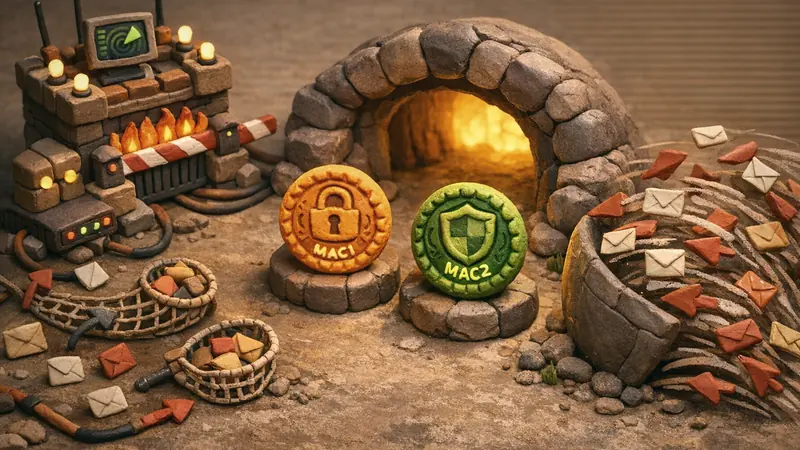
Virtual private network gateways operating on public infrastructure face a continuous stream of unauthenticated traffic. Under standard operating conditions, cryptographic tunnels authenticate peers through public-key handshakes. However, during distributed denial-of-service (DDoS) events, malicious actors exploit asymmetric computational costs: an adversary generates millions of forged UDP initiation packets with minimal bandwidth, while the receiving gateway must execute expensive cryptographic operations and allocate session state in kernel memory.
Traditional VPN architectures such as OpenVPN and IPsec IKEv2 struggle in these scenarios. They allocate transmission control structures or security association (SA) buffers upon receiving an initial probe, exposing their operating system queues to memory depletion. WireGuard eliminates this attack vector entirely. By enforcing strict statelessness prior to completed handshakes and implementing a two-tier message authentication code (mac1 and mac2) system backed by rotating cryptographic cookies, WireGuard shields server resources from saturation.
Inside the Linux kernel implementation, this defensive mechanism is orchestrated by drivers/net/wireguard/cookie.c. Understanding its cryptographic design reveals how high-speed tunnels sustain line-rate resilience without conceding state to unverified initiators.
The Asymmetric Handshake Challenge and Stateless Resilience
The Noise IK pattern utilized by WireGuard requires mutual authentication using Curve25519 Diffie-Hellman scalar multiplications. Performing point multiplication on an elliptic curve requires substantial CPU cycles compared to standard packet routing. If a VPN server accepted every incoming Type 1: Handshake Initiation packet and immediately computed the shared secret, an attacker sending spoofed UDP packets could easily monopolize all CPU cores, starving active tunnels of throughput.
WireGuard resolves this vulnerability by splitting packet verification into distinct operational tiers:
[ Incoming Handshake Packet ]
              │
              ▼
   Verify MAC1 (Static Key)
      ├─ Invalid ──► Silent Drop (Zero Response)
      └─ Valid
              │
              ▼
   Gateway Under Load? (ratelimiter.c)
      ├─ No  ──► Process Curve25519 ScalarMult
      └─ Yes
              │
              ▼
   Verify MAC2 (Rotating Cookie)
      ├─ Valid   ──► Process Curve25519 ScalarMult
      └─ Invalid ──► Emit Type 3: Cookie Reply (Stateless)
In nominal states where system load remains below the threshold defined in ratelimiter.c, the server verifies mac1 and proceeds with the cryptographic exchange. When packet volume threatens CPU saturation, the gateway activates its secondary barrier, requiring all incoming handshakes to present a valid mac2 token derived from a server-issued cookie.
The Anatomy of Dual-Tier MAC Verification (mac1 vs mac2)
Every WireGuard initiation packet reserves two 16-byte fields at the tail of its structure: mac1 (bytes 116–131) and mac2 (bytes 132–147). These fields operate as complementary gates:
mac1Gate: Calculated asBLAKE2s-128(key = Hash(Label-Mac1 || Responder_PublicKey), message = packet[0..115]). Becausemac1is keyed with a hash of the server's public key, only clients configured with the correct server identity can generate a valid tag. Packets from random scanners or misconfigured endpoints failmac1and are dropped silently without generating ICMP port unreachable replies.mac2Gate: Calculated asBLAKE2s-128(key = Cookie, message = packet[0..131]). Notice thatmac2covers the entire packet, including the validmac1field. The 16-byte key used formac2is an ephemeral cryptographic cookie provided exclusively by the server to proven IP addresses.
Under normal network conditions, clients transmit mac2 populated with sixteen null bytes (0x00). When the server enters defensive mode, packets with zeroed or mismatched mac2 values are denied cryptographic processing. Instead of allocating a peer entry or dropping the packet, the server executes a stateless challenge-response sequence.
In-Kernel Mechanics of cookie.c: Stateless Challenge-Response
When ratelimiter.c signals overload, cookie.c takes ownership of the interaction through wg_cookie_checker_create_payload(). The kernel constructs a 64-byte Type 3: Handshake Cookie Reply packet structured as follows:
┌────────────────────────────────────────────────────────┐
│ Type: 3 (1 byte) │ Reserved: 0 (3 bytes)               │
├────────────────────────────────────────────────────────┤
│ Receiver Index: Client's sender_index (4 bytes)        │
├────────────────────────────────────────────────────────┤
│ XChaCha20 Nonce: Generated from CSPRNG (24 bytes)      │
├────────────────────────────────────────────────────────┤
│ Encrypted Cookie Token: XChaCha20-Poly1305 (32 bytes)  │
│ - 16 bytes plaintext cookie                            │
│ - 16 bytes Poly1305 authentication tag                 │
└────────────────────────────────────────────────────────┘
The construction of this reply requires negligible CPU overhead. Crucially, the server allocates zero bytes of dynamic heap memory (kmalloc). The outgoing packet echoes the client's sender_index so the client can map the cookie to its pending handshake, while the sensitive cookie payload is encrypted using XChaCha20-Poly1305.
The symmetric encryption key for the cookie is computed deterministically:
Cookie_Encryption_Key = BLAKE2s-256(
    key = Hash(Label-Cookie || Responder_PublicKey),
    message = Initiator_MAC1
)
Because Initiator_MAC1 was already validated by the server, it serves as a unique cryptographic salt for that specific handshake attempt, preventing eavesdroppers from pre-computing decryption keys.
Secret Entropy Rotation and Proof of IP Ownership
The core security property of WireGuard's cookie mechanism is establishing proof of IP ownership without recording state. The server derives the cookie using an internal 32-byte secret (cookie_checker->secret) generated from the kernel's cryptographically secure pseudo-random number generator (get_random_bytes).
The calculation binds the initiator's physical network address directly into the cookie:
Cookie = BLAKE2s-128(
    key = cookie_checker->secret,
    message = Initiator_IP_Address || Initiator_Port
)
To prevent attackers from hoarding valid cookies across extended attack windows, the server rotates this secret every 120 seconds (COOKIE_SECRET_MAX_AGE = 120).
To handle packet jitter and round-trip delays, cookie.c stores two generations of secrets:
secret[0]: The active secret used for generating new cookies and validating fresh arrivals.secret[1]: The previous secret from the preceding 120-second epoch, allowing in-flight handshakes to authenticate cleanly during rotation boundaries.
When an attacker launches a distributed flood using spoofed source IP addresses, the server transmits Type 3: Cookie Reply packets back to those forged IPs over UDP. Because the adversary does not control the routed endpoints, they never observe the encrypted cookie payload.
Conversely, a legitimate client receiving the Cookie Reply executes wg_cookie_message_consume(). It decrypts the token, stores it in its local cache (peer->latest_cookie), sets cookie_birthdate = jiffies, and immediately retransmits its Handshake Initiation packet with mac2 properly populated. The server validates mac2 in constant time, confirms the client owns its source IP, and proceeds with Curve25519 key derivation.
Lockless Concurrency and RiceGuard Architecture
The performance of cookie.c stems from its lockless design. Reading the rotating secrets and computing authentication tags occurs within an rcu_read_lock() critical section. The server avoids global spinlocks on the receive datapath, allowing all available CPU cores to evaluate mac1 and mac2 in parallel without memory bus thrashing.
Incoming Handshake ──► [NIC Rx Queue] ──► RCU Read Lock ──► BLAKE2s MAC Verify ──► Worker Thread
In high-concurrency production deployments, VPN gateways face extreme bursts exceeding tens of millions of packets per second. At VPNRice, the RiceGuard network engine enhances this kernel mechanism by coupling cookie.c with eBPF and XDP (eXpress Data Path) hardware acceleration.
By calculating and verifying dual-tier MACs directly within the network interface driver before sk_buff socket allocation, RiceGuard deflects volumetric spoofing attacks at the physical boundary. Legitimate users experience seamless session initiation, enjoying consistent forward secrecy and ultra-low latency even during coordinated infrastructure stress.