 Tiếng Việt
 English
 中文
 Español
 हिन्दी
 Français
 Português
 Русский
 Deutsch
 日本語
 한국어
 Italiano
 Bahasa Indonesia
 ไทย
 বাংলা
 ລາວ
 မြန်မာ
 العربية
 فارسی
 اردو
 Українська
 Română
 Azərbaycan
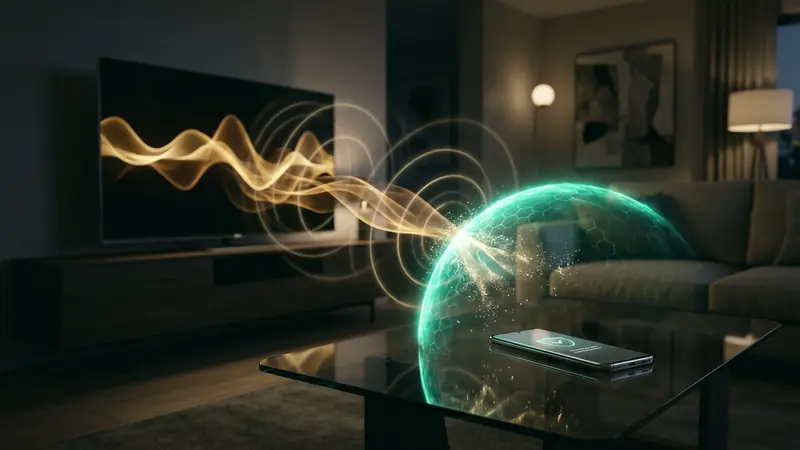
You are sitting in your living room enjoying an evening movie or streaming an online broadcast on your connected smart television. A brief commercial airs, displaying an advertisement for a niche outdoor camping tent. You have never searched for camping equipment, never mentioned outdoor gear in conversation, and never linked your streaming account to your personal smartphone. Yet, thirty seconds later, when you casually unlock your phone to check a morning news feed, a sponsored banner for that exact camping tent stares back at you.
This eerie synchronization is neither coincidence nor telepathy. Your household devices were linked across the room without pairing, Bluetooth discovery, or a physical cable. You have just experienced Ultrasonic Cross-Device Tracking (uXDT)—a covert surveillance technique that exploits high-frequency sound waves beyond human hearing to bridge digital identities between disconnected screens.
The Acoustic Physics of Ultrasonic Beacons
To understand how ultrasonic surveillance operates across household hardware, one must look at the acoustic capabilities of modern consumer electronics. The human auditory system typically perceives sound frequencies between 20 Hz and 20,000 Hz (20 kHz). However, standard audio speakers installed in televisions, laptops, and retail sound systems are capable of reproducing frequencies reaching up to 24 kHz. Simultaneously, the micro-electro-mechanical systems (MEMS) microphones embedded in smartphones and tablets are highly sensitive to frequencies well into the 18 kHz to 22 kHz spectrum.
Commercial advertising networks weaponize this acoustic gap by embedding ultrasonic beacons directly into the audio tracks of television broadcasts, streaming videos, podcast advertisements, and retail background music. These beacons are structured using audio frequency-shift keying (AFSK) or direct-sequence spread spectrum (DSSS) modulation:
Beacon Emission: When an ad plays on a television or desktop monitor, the speaker transmits short, imperceptible audio chirps modulated between 18.5 kHz and 21 kHz. To the human ear, the room remains completely quiet, or the tone blends invisibly beneath dialogue and background music.
In-App Acoustic Snooping: On your nearby smartphone, an innocent-looking mobile app—such as a free casual game, a utility flashlight, or a coupon aggregator—runs in the background. During installation, the app requested microphone permissions under the guise of voice search or audio enhancements. Embedded within the app is a third-party advertising SDK (such as codebases pioneered by SilverPush, Lisnr, or Signal360).
Demultiplexing and Decoding: The app's audio processing thread continuously listens to ambient room noise through the microphone, passing low-latency pulse-code modulation (PCM) audio frames through a high-pass digital bandpass filter. When the filter detects an ultrasonic burst, the SDK demodulates the packet to extract an encrypted advertiser payload containing a campaign identifier, broadcaster timestamp, and retailer tag.
Cross-Device Correlation: How Acoustic Beacons Link Personas
Extracting the acoustic payload inside the mobile app is only the first half of the tracking pipeline. The ultimate objective of uXDT is to bind multiple fragmented personas into a single, comprehensive surveillance profile.
Once the mobile SDK extracts the ultrasonic payload from ambient room air, it constructs an immediate telemetry report. The application dispatches an outbound HTTP POST or secure WebSocket message to the advertising network's centralized collection server. This telemetry packet combines the ultrasonic campaign identifier with a rich cluster of local device identifiers:
- Hardware and Ad Identifiers: The mobile phone's Google Advertising ID (GAID), Apple Identifier for Advertisers (IDFA), hardware serial hashes, and device model.
- Geographical and Network Context: Exact GPS coordinates, neighboring Wi-Fi BSSIDs, and the device's public IP address.
At the advertising server, automated identity-resolution algorithms cross-reference this mobile telemetry with parallel logs collected from the smart television's automatic content recognition (ACR) system. By matching the precise timestamp of the broadcast, the shared ultrasonic beacon ID, and identical public IP routing headers, the ad network confirms that the smartphone owner is sitting directly in front of that specific smart TV screen.
The consequences for personal privacy are severe. Marketers link anonymous desktop browsing, living room viewing habits, and mobile purchasing histories into an unbroken consumer identity graph. Political campaign strategists identify which family members watch specific television news broadcasts, while aggressive data brokers track visits to physical retail storefronts equipped with ultrasonic ceiling emitters.
Countermeasures: Revoking Permissions and Breaking IP Correlation
Neutralizing ultrasonic surveillance requires a dual-pronged defense that tackles both local hardware audio collection and network-layer identity resolution:
Audit and Revoke Mobile Microphone Permissions
The local acoustic bridge depends entirely on mobile apps maintaining active access to your device's physical microphone. Perform a strict hardware audit:
- Android Users: Navigate to Settings > Privacy > Permission manager > Microphone. Review every app with mic access and revoke permissions for games, calculators, retail apps, and utilities that have no legitimate reason to record audio.
- iOS Users: Go to Settings > Privacy & Security > Microphone and disable microphone toggles for all non-essential third-party applications. Both Android and iOS now display visual indicator dots (green or orange) whenever an app accesses the microphone.
Break Subnet Correlation with Encrypted Tunnels
While microphone hygiene restricts rogue apps, sophisticated ad networks also combine ultrasonic tracking with network-layer fingerprinting. If both the television and the smartphone report to the ad server from the identical residential public IP address, the network graph reinforces the device association.
Running VPNRice across your personal devices breaks this correlation completely. When you route mobile traffic through an encrypted tunnel powered by ChaCha20-Poly1305 or AES-256-GCM, your smartphone's public egress IP address is decoupled from your home router's residential IP. The proprietary obfuscation protocols RiceGuard and RiceGuardX ensure that telemetry packets dispatched by background apps cannot correlate with your living room's residential subnet.
Before settling into your home entertainment environment, verify your active public routing profile using the IP lookup tool, and confirm that your mobile browser does not leak local connection endpoints through our WebRTC leak test utility. By combining strict microphone permission controls with persistent tunnel encryption, you dismantle the acoustic surveillance bridge and keep your personal screens truly separated.