Tiếng Việt
 English
 中文
 Español
 हिन्दी
 Français
 Português
 Русский
 Deutsch
 日本語
 한국어
 Italiano
 Bahasa Indonesia
 ไทย
 বাংলা
 ລາວ
 မြန်မာ
 العربية
 فارسی
 اردو
 Українська
 Română
 Azərbaycan
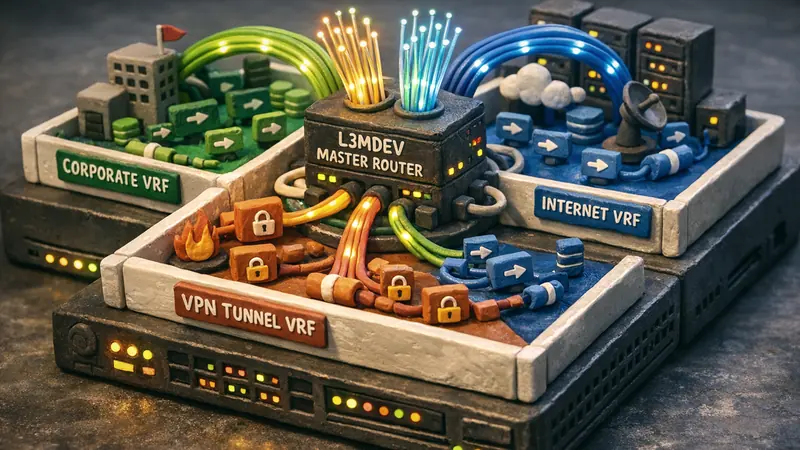
In traditional Linux networking architectures, every network interface shares a single global routing table—the main Forwarding Information Base (FIB). When operating standard desktops or single-homed servers, this unified routing model operates without incident.
However, in multi-tenant environments, multi-WAN edge routers, and secure virtual private network (VPN) gateways, the single-table model introduces fundamental security and operational vulnerabilities. When multiple interfaces share a routing domain, default gateway race conditions frequently emerge. If an encrypted tunnel interface terminates unexpectedly, traffic may immediately fall back to physical transit links (such as Wi-Fi or Ethernet), exposing unencrypted datagrams and DNS lookups to local observers.
Network engineers historically addressed this routing collision problem using Linux Network Namespaces (netns). While network namespaces provide total isolation by duplicating the entire networking stack—including sockets, interfaces, loopback devices, netfilter rules, and sysctl configurations—they introduce severe performance penalties. Shuttling packets between namespaces requires virtual Ethernet (veth) pairs or eBPF socket redirection programs, creating duplicate sk_buff allocations, cache thrashing, and throughput bottlenecks at 40GbE and 100GbE line rates.
To deliver carrier-grade routing isolation without the virtualization overhead of namespaces, the Linux kernel introduced Virtual Routing and Forwarding (VRF) backed by the Layer 3 Master Device (l3mdev) subsystem.
+--------------------------------------------------------------------------+
|          LINUX VRF & L3MDEV MULTI-TABLE ROUTING ARCHITECTURE             |
+--------------------------------------------------------------------------+
|                                                                          |
|   +------------------------------------------------------------------+   |
|   |                      USERSPACE APPLICATIONS                      |   |
|   |                                                                  |   |
|   |   +-------------------+                     +----------------+   |   |
|   |   |  Protected Client |                     |  Management    |   |   |
|   |   |  (ip vrf exec)    |                     |  Daemon (SSH)  |   |   |
|   +---+---------+---------+---------------------+--------+-------+---+   |
|                 | SO_BINDTODEVICE                        |               |
|                 v (vrf-secure)                           v               |
|   +------------------------------------------------------------------+   |
|   |                     LINUX KERNEL NETWORKING                      |   |
|   |                                                                  |   |
|   |   [ VRF Master: vrf-secure ]           [ Default VRF / Global ]  |   |
|   |   [ Table ID: 100          ]           [ Table ID: 254 (main) ]  |   |
|   |                                                                  |   |
|   |   FIB Lookup (Scoped):                 FIB Lookup (Global):      |   |
|   |   default dev riceguard0               default via 192.168.1.1   |   |
|   |   10.8.0.0/24 dev riceguard0           192.168.1.0/24 dev eth0   |   |
|   |             |                                    |               |   |
|   |             |                                    |               |   |
|   |   +---------v---------+                +---------v---------+     |   |
|   |   | Slaved Netdev:    |                | Physical Netdev:  |     |   |
|   |   | riceguard0        |                | eth0 (WAN / Wi-Fi)|     |   |
|   |   +---------+---------+                +---------+---------+     |   |
|   +-------------|------------------------------------|---------------+   |
|                 v                                    v                   |
|     +-----------------------+            +-----------------------+       |
|     | Encrypted VPN Tunnel  |            | Local Network Uplink  |       |
|     | (Zero Leak Isolation) |            | (No Traffic Leakage)  |       |
|     +-----------------------+            +-----------------------+       |
|                                                                          |
+--------------------------------------------------------------------------+
The Architecture of Linux VRF and the l3mdev Subsystem
Virtual Routing and Forwarding in Linux is implemented as a specialized virtual network device driver (drivers/net/vrf.c). Rather than duplicating networking state like network namespaces, a VRF master device simply encapsulates a dedicated routing table ID within the kernel.
Physical or virtual network interfaces are enslaved to the VRF master device using standard netlink commands. Once enslaved, the kernel’s Layer 3 Master Device infrastructure intercepts forwarding decisions:
1. Ingress and Egress FIB Scoping
When an IP datagram arrives on an interface enslaved to a VRF, the kernel queries the l3mdev driver associated with that interface. The l3mdev callback overrides the default routing lookup table, directing the FIB search directly to the VRF's designated table (for example, Table 100).
Because routes inside Table 100 have no visibility into the main routing table (Table 254), cross-table route leakage is cryptographically and architecturally prevented:
- Strict Ingress Filtering: Reverse path filtering (rp_filter) evaluates source addresses within the context of the VRF's routing table, blocking spoofed packets from adjacent interfaces.
- Strict Egress Binding: Packets originated by applications bound to the VRF cannot match default routes located in the global table.
2. Socket-to-VRF Association
Applications can associate their network traffic with a specific VRF using three distinct mechanisms:
SO_BINDTODEVICESocket Option: A process binds an individual socket descriptor to the VRF master device name (such asvrf-secure). All read and write syscalls executed on that socket inherit the VRF's routing table.- Cgroups v2 and
ip vrf exec: Using the BPF cgroup network hook (cgroup/sock_create), system administrators can launch entire process trees inside a VRF without altering source code. Theip vrf exec <name> <command>utility uses this mechanism. SO_BINDTOIFINDEX: A high-performance alternative enabling lockless interface binding at the socket layer.
+--------------------------------------------------------------------------+
|             ISOLATION MECHANISMS: VRF VS. NETWORK NAMESPACES             |
+--------------------------------------------------------------------------+
| Architectural Property | VRF (l3mdev)            | Network Namespaces    |
+------------------------+-------------------------+-----------------------+
| Routing Separation     | Strict per-table FIB    | Total stack duplicate |
| Memory Footprint       | Negligible (<10 KB/vrf) | High (>1 MB/netns)    |
| Inter-Domain Forward   | Zero-copy in kernel     | veth / BPF overhead   |
| Socket Space           | Shared across host      | Completely isolated   |
| Sysctl Tuning          | Unified host management | Per-netns duplicated  |
| Line-Rate Forwarding   | 40GbE - 100GbE wire-rate| Degraded under load   |
+--------------------------------------------------------------------------+
Resolving Multi-Tenant Services with tcp_l3mdev_accept
A recurring hurdle in multi-table routing involves listening daemons. In a traditional setup, if a DNS resolver (such as Unbound) or an SSH daemon binds to the wildcard address 0.0.0.0:53, it resides solely in the default VRF. Enslaved interfaces inside other VRFs cannot establish connections with the daemon because their FIB lookups are strictly compartmentalized.
To solve this without launching duplicate daemon processes for every customer or routing slice, the Linux kernel provides specialized sysctl switches:
# Allow TCP daemons in the global VRF to accept connections across all VRFs
sysctl -w net.ipv4.tcp_l3mdev_accept=1

# Allow UDP daemons in the global VRF to receive datagrams across all VRFs
sysctl -w net.ipv4.udp_l3mdev_accept=1
When tcp_l3mdev_accept is enabled, an incoming TCP SYN packet received on an enslaved VRF interface matches a global listening socket. When the kernel creates the accepted child socket, it automatically binds the child socket to the incoming interface's VRF master device.
All subsequent response packets transmitted by that child socket route deterministically back through the originating VRF, preventing asymmetrical routing and silent connection drops.
Step-by-Step Configuration: Deploying a Zero-Leak VPN Gateway
Configuring VRF on Linux edge nodes requires only iproute2 utilities. Below is a practical implementation creating a dedicated VRF domain for a secure tunneling interface:
Step 1: Create the VRF Master Device
Create a VRF netdev named vrf-vpn linked to dedicated routing table 100:
# Create VRF master device bound to table 100
ip link add dev vrf-vpn type vrf table 100

# Bring the VRF master interface up
ip link set dev vrf-vpn up
Step 2: Enslave Tunnel and Client Interfaces
Attach the VPN tunneling interface (riceguard0) and the private client VLAN (vlan20) to the VRF master device:
# Enslave interfaces into vrf-vpn
ip link set dev riceguard0 master vrf-vpn
ip link set dev vlan20 master vrf-vpn

# Bring physical/tunnel interfaces up
ip link set dev riceguard0 up
ip link set dev vlan20 up
Step 3: Populate the VRF Routing Table
Configure routing within Table 100. Any traffic originating within vrf-vpn will only be able to reach destinations defined in this table:
# Add point-to-point subnet for the VPN tunnel
ip route add 10.8.0.0/24 dev riceguard0 table 100

# Add local private client subnet
ip route add 192.168.20.0/24 dev vlan20 table 100

# Direct all external egress exclusively through the encrypted tunnel
ip route add default dev riceguard0 table 100
Step 4: Verification and Diagnostics
Verify the routing domain isolation by executing diagnostic tools constrained to vrf-vpn:
# Show routes inside the VRF table
ip route show table 100

# Test ping through the VRF domain
ip vrf exec vrf-vpn ping -c 3 10.8.0.1

# Verify that global routing table (table 254) remains untouched
ip route show table main
If the riceguard0 tunnel goes down, traffic inside Table 100 cannot resolve a gateway. Because the physical interface (eth0) belongs to the global routing table, client packets inside vlan20 are discarded immediately at the kernel routing stage rather than leaking over unencrypted local networks.
Integration Synergies with RiceGuard and VPNRice
Within VPNRice's production infrastructure, the high-throughput RiceGuard kernel tunneling engine couples directly with Linux VRF and l3mdev primitives to achieve distinct security guarantees:
- Deterministic Prevention of DNS and IPv6 Leaks: Desktop and mobile operating systems frequently attempt to dispatch parallel DNS queries across all active network adapters. By placing the RiceGuard tunnel adapter and its recursive resolver inside an isolated VRF domain, queries cannot traverse physical network links.
- Zero-Overhead Multi-WAN Policy Routing: Concentrator gateways terminating thousands of concurrent client tunnels utilize VRF instances to isolate distinct tenant topologies. Unlike network namespace deployments that degrade under high packet-per-second loads, VRF forwards packets at line rate with zero memory copying.
- Resilient Management Plane Isolation: Gateway administrative interfaces (SSH, metric exporters, monitoring daemons) are confined to a dedicated out-of-band management VRF. Compromised user tunnels have zero network reachability to administrative daemons, enforcing strict zero-trust boundaries in software.
Operational Considerations and Production Best Practices
When deploying VRF-based multi-table isolation in production environments, network architects should observe key implementation rules:
- Strict Source Address Validation: Enable strict Reverse Path Forwarding (
net.ipv4.conf.all.rp_filter=1) to prevent IP spoofing between adjacent VRF domains. - Firewall Scoping: Use
nftablesoriptableswith theiifnameoroifnamematches targeting the VRF master device to enforce unified access control policies across all enslaved interfaces. - Sysctl Namespacing: Be aware that unlike network namespaces, VRF devices share the host kernel’s memory and connection tracking tables (
conntrack). Ensurenf_conntrack_maxis scaled appropriately to support aggregate concurrent flows across all VRF instances.
The combination of Linux VRF and the l3mdev framework delivers robust routing compartmentalization without sacrificing wire-speed packet processing. For modern VPN gateways, it remains the gold standard architecture for eliminating data leaks while ensuring clean operational isolation.