Tiếng Việt
 English
 中文
 Español
 हिन्दी
 Français
 Português
 Русский
 Deutsch
 日本語
 한국어
 Italiano
 Bahasa Indonesia
 ไทย
 বাংলা
 ລາວ
 မြန်မာ
 العربية
 فارسی
 اردو
 Українська
 Română
 Azərbaycan

The deployment of large language models (LLMs) in high-throughput enterprise production has triggered a paradigm shift in distributed systems design. Traditional monolithic serving architectures—where a single GPU cluster handles both the prompt ingestion and the subsequent token generation—suffer from severe computational inefficiency. Prompt processing (the prefill phase) is compute-bound, maximizing tensor core arithmetic saturation, whereas token generation (the decode phase) is memory-bandwidth-bound, constrained by high-bandwidth memory (HBM) latency.
To maximize GPU hardware utilization and minimize time-to-first-token (TTFT) alongside inter-token latency (ITL), leading inference frameworks have transitioned to disaggregated serving architectures. In systems such as DistServe, Mooncake, and vLLM disaggregated deployments, prefill nodes and decode nodes reside on distinct physical servers, communicating over high-speed local networks.
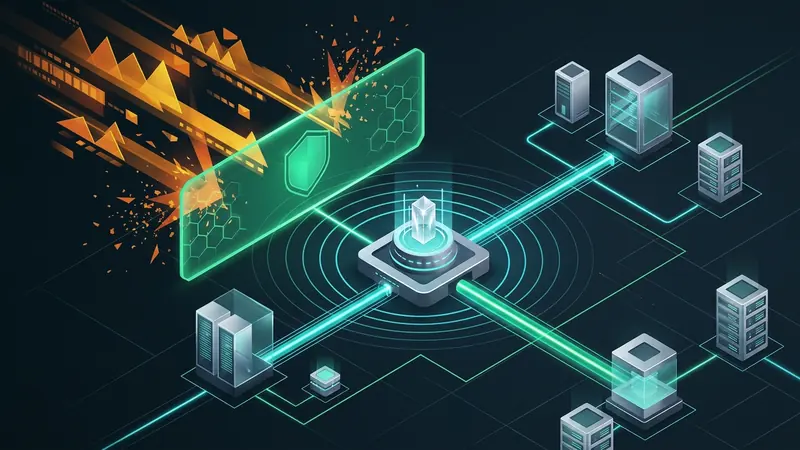
However, this architectural separation introduces an acute, under-analyzed security exposure: the transmission of unencrypted Key-Value (KV) cache tensors across inter-node network fabrics. When gigabytes of raw floating-point attention matrices traverse cloud networks in plaintext, eavesdroppers and malicious co-tenants can reconstruct private user prompts, execute attention state poisoning, or conduct prefix hijacking. Securing this critical datapath requires deterministic Layer 3 cryptographic isolation.
+--------------------------------------------------------------------------+
|      Monolithic vs. Disaggregated Distributed LLM Serving Topologies     |
+--------------------------------------------------------------------------+
|  MONOLITHIC SERVING (Shared Node):                                       |
|  User Prompt ──> [ GPU Node: Prefill Phase ──> Shared HBM Memory ]       |
|                                                     │                    |
|                                                     ▼                    |
|                  [ Decode Phase generates tokens from local HBM ]        |
|  * KV Cache remains inside physical GPU HBM / NVLink crossbars.          |
+--------------------------------------------------------------------------+
|  DISAGGREGATED SERVING (Network-Separated Clusters):                     |
|  User Prompt ──> [ Prefill Cluster Node ] (Compute-Bound Processing)     |
|                         │                                                |
|                         ▼ Raw KV Cache Chunks (TCP / RDMA / RoCE)        |
|  ══════════════════════════════════════════════════════════════════════  |
|      UNENCRYPTED INTER-NODE CLUSTER NETWORK (Vulnerable to Sniffing)     |
|  ══════════════════════════════════════════════════════════════════════  |
|                         │                                                |
|                         ▼                                                |
|                  [ Decode Cluster Node ] (Memory-Bandwidth Bound)        |
|  * Gigabytes of floating-point prompt tokens traverse physical switches. |
+--------------------------------------------------------------------------+
The Mechanics of Disaggregated KV Cache Streaming
To understand the vulnerability footprint, one must inspect how transformer attention operates during distributed inference. In modern decoder-only transformers, the attention mechanism computes relationships across tokens using Query ($Q$), Key ($K$), and Value ($V$) projections:
$$\text{Attention}(Q, K, V) = \text{softmax}\left(\frac{QK^T}{\sqrt{d_k}}\right)V$$
During the prefill phase, the prefill worker processes the entire context window—often tens of thousands of prompt tokens containing proprietary documents, user credentials, system instructions, and database records. It calculates the resulting Key and Value tensor representations for every transformer layer and attention head.
In a disaggregated setup:
- Chunked Allocation: The prefill engine allocates logical KV memory blocks (using paging abstractions like PagedAttention or Radix trees).
- Serialization & Dispatch: Upon finishing prefill computation, the worker packages the multi-dimensional FP16, BF16, or quantized FP8/INT4 tensors into network transmission buffers.
- Network Transit: The serialized KV cache is streamed to designated decode worker nodes via high-bandwidth socket protocols, gRPC streams, or unencrypted Remote Direct Memory Access over Converged Ethernet (RoCEv2).
- Decode Hydration: The decode worker unpacks the tensors directly into its local HBM pool and begins auto-regressive generation, appending one token at a time without recomputing the prompt.
Because token context windows commonly reach 32k to 128k tokens, a single session's KV cache routinely spans multiple gigabytes of memory. In multi-tenant cloud clusters, these large data streams flow continuously across Top-of-Rack (ToR) switches and software-defined overlay networks.
+--------------------------------------------------------------------------+
|                 Anatomy of a Disaggregated KV Cache Packet               |
+--------------------------------------------------------------------------+
|  [ IP / Transport Header (TCP Port 50051 / RoCE QP Header) ]             |
|  [ Inference Engine Metadata: Request ID, Tenant ID, Sequence Length ]   |
|  [ Layer Index: Layer 0..N-1 | Head Dimension: d_k = 128 ]                |
|  [ Key Tensor Data: Floating-point matrices (BF16 / FP16 / FP8) ]         |
|  [ Value Tensor Data: Floating-point matrices (BF16 / FP16 / FP8) ]       |
|  * High mathematical correlation with source token embedding space       |
+--------------------------------------------------------------------------+
The Threat Vector: Passive Sniffing and Prompt Inversion
Cloud environments frequently host multi-tenant AI clusters across shared physical hardware, virtual private clouds (VPCs), or Kubernetes namespaces. If an adversary gains access to a compromised container on the same host, compromises an adjacent virtual switch, or exploits software-defined networking (SDN) mirroring, unencrypted KV traffic becomes immediately accessible.
1. Mathematical Token Inversion Attacks
A common misconception is that raw Key and Value tensors are opaque mathematical vectors that cannot reveal plain text. Recent security research proves otherwise.
The Key and Value tensors are linear projections of the hidden representations generated by transformer attention layers:
$$K = X W_k, \quad V = X W_v$$
Because the projection weights ($W_k, W_v$) of open-weight foundational models (such as Llama, Mistral, or Qwen) are publicly known, an adversary intercepting $K$ and $V$ tensors can solve an inverse optimization problem. By computing:
$$\hat{X} \approx K W_k^+ \quad \text{or} \quad \hat{X} \approx V W_v^+$$
where $W^+$ denotes the Moore-Penrose pseudoinverse, an attacker approximates the hidden states $\hat{X}$. Passing $\hat{X}$ backward through the transformer unembedding matrix recovers the original natural language prompt with startling accuracy. Proprietary IP, confidential medical records, internal source code, and API credentials embedded in the prompt context are exposed without the attacker ever interacting directly with the model endpoint.
+--------------------------------------------------------------------------+
|              Attention Tensor Inversion Exfiltration Pipeline            |
+--------------------------------------------------------------------------+
|  Inter-Node Traffic Sniffed: Key/Value Tensors (Layer 0..3)              |
|         │                                                                |
|         ▼ (Apply Pseudoinverse of Public Layer Weights W_k+, W_v+)       |
|  Reconstructed Hidden State Vector (\hat{X})                             |
|         │                                                                |
|         ▼ (Multiply by Model Unembedding Matrix W_u)                     |
|  Calculated Vocabulary Logits: Softmax(\hat{X} * W_u)                    |
|         │                                                                |
|         ▼ (Argmax Projection to Plaintext Tokens)                        |
|  Recovered Prompt: "Authorization: Bearer sk-live-94819..."              |
|  ==> Critical Confidentiality Breach on Transit Network                  |
+--------------------------------------------------------------------------+
2. Cross-Tenant Prefix Cache Hijacking
High-efficiency inference engines utilize prefix caching to reuse KV blocks across multiple users who share identical system prompts or reference documents.
In an unauthenticated network fabric:
- An attacker can inject counterfeit KV completion packets into the decode node's incoming stream, spoofing the sequence hash of a common system prompt.
- By replacing legitimate prefix blocks with adversarial KV states, the attacker alters the model's safety alignments, induces hallucinated instructions, or plants persistent backdoors into subsequent user generations without tampering with model weights.
Deterministic Defense: Kernel WireGuard Cryptographic Enclaves
Application-level encryption (such as TLS wrappers around gRPC or custom cryptographic handshakes inside inference engines) introduces severe CPU serialization overhead, memory copying delays, and driver incompatibilities with high-throughput network cards.
The definitive solution is establishing deterministic Layer 3 cryptographic isolation directly within the operating system kernel using a hardened WireGuard mesh architecture.
+--------------------------------------------------------------------------+
|       Hardened Architecture: Layer 3 WireGuard AI Cluster Enclave        |
+--------------------------------------------------------------------------+
|                                                                          |
|   Prefill GPU Worker Node                                                |
|   - Generates KV Cache Blocks for Prompt Request                         |
|   - Transmits to Decode Node IP (10.200.0.2)                             |
|                 │                                                        |
|                 ▼                                                        |
|   [Kernel WireGuard Interface (wg0) / ChaCha20-Poly1305 Engine]          |
|   - Enforces strict Cryptokey Routing (Source: 10.200.0.1)               |
|   - Encapsulates payload at wire speed inside kernel datapath            |
|                 │                                                        |
|                 ▼ (Encrypted UDP Datagram: Port 51820)                   |
|   ====================================================================   |
|            PHYSICAL SWITCH FABRIC / SHARED CLOUD VPC BACKBONE            |
|            (Eavesdropper sees only opaque ChaCha20 cipher stream)        |
|   ====================================================================   |
|                 │                                                        |
|                 ▼                                                        |
|   [Decode Node Kernel WireGuard Interface (wg0)]                         |
|   - Authenticates Poly1305 MAC tag and decrypts in kernel memory         |
|   - Delivers validated plaintext KV stream directly to inference engine  |
|                 │                                                        |
|                 ▼                                                        |
|   Decode GPU Worker Node (Hydrates local HBM securely)                   |
|                                                                          |
+--------------------------------------------------------------------------+
1. Peer-to-Peer Cryptokey Routing and Interface Binding
WireGuard's Cryptokey Routing model provides cryptographic guarantees tailored for distributed AI clusters:
- Immutable Peer Association: Each prefill and decode worker node generates a Curve25519 static key pair. The WireGuard interface maps allowed IP addresses directly to public keys.
- Spoofing Prevention: If a malicious pod attempts to send fabricated KV tensors or forge IP addresses, the kernel immediately drops the packets because the cryptographic signature fails to match the peer record.
- Zero-Copy Performance: WireGuard runs directly inside the Linux kernel network stack, avoiding expensive user-to-kernel context switches. When paired with network interfaces supporting UDP encapsulation offload, throughput remains near line rate.
2. Gateway Egress Policy and Cluster Segmentation
To ensure that AI worker nodes cannot be coerced into exfiltrating KV cache data or token streams to unauthorized external endpoints, administrators deploy granular packet filter rules using nftables:
# Define dedicated AI inference cluster interface
# Isolate all inter-node inference traffic strictly to WireGuard mesh (wg0)
nft add table inet ai_enclave
nft add chain inet ai_enclave forward { type filter hook forward priority 0; policy drop; }

# Permit bidirectional KV cache transfer between authenticated worker peers
nft add rule inet ai_enclave forward iifname "wg0" oifname "wg0" ip saddr 10.200.0.0/24 ip daddr 10.200.0.0/24 accept

# Drop all unauthorized outbound egress attempts from AI nodes to public WAN
nft add rule inet ai_enclave forward iifname "wg0" oifname "wan" drop

# Enforce strict WireGuard port binding on physical network interfaces
nft add chain inet ai_enclave input { type filter hook input priority 0; policy drop; }
nft add rule inet ai_enclave input iifname "eth0" udp dport 51820 accept
nft add rule inet ai_enclave input iifname "lo" accept
3. Securing Administrative and Monitoring Channels
In addition to inter-node KV cache streaming, modern LLM clusters utilize administrative control planes (such as Ray, Kubernetes API, or Prometheus metrics endpoints). Exposing these services over unsegmented local networks allows attackers to query inference statistics, trigger unauthorized checkpoint saves, or alter routing tables.
By routing all cluster orchestration, health checks, and metrics traffic through isolated VPN interfaces, the control plane is decoupled from the underlying physical infrastructure, eliminating lateral movement vectors.
Architectural Comparison: Application-Level vs. Layer 3 Defense
Evaluating mitigation strategies for disaggregated AI architectures highlights critical trade-offs in throughput, operational complexity, and security posture:
| Evaluation Dimension | Plaintext Disaggregated Inference | Application TLS / Custom Crypto | Hardened Layer 3 WireGuard Mesh |
|---|---|---|---|
| Confidentiality | None; completely exposed on network | Secured via user-space TLS wrappers | Cryptographically secured via ChaCha20 |
| Prompt Inversion Resilience | Extremely vulnerable to tensor math | Protected if TLS cipher suites hold | Protected; no raw tensor access |
| Throughput & Latency | Maximum raw line speed | Significant latency penalty from copies | Near line speed via kernel datapath |
| Prefix Spoofing Defense | Vulnerable to packet injection | Dependent on application certificate validation | Enforced at kernel level via Cryptokey Routing |
| Operational Scope | Zero configuration | High; requires modifying engine source code | Transparent; zero changes to model code |
Disaggregated LLM inference delivers undeniable economic and operational efficiency for modern AI operations. However, distributing the transformer memory pipeline across physical servers fundamentally alters the enterprise attack surface. Implementing deterministic Layer 3 network isolation ensures that high-throughput generative AI infrastructure remains both computationally scalable and cryptographically resilient.